

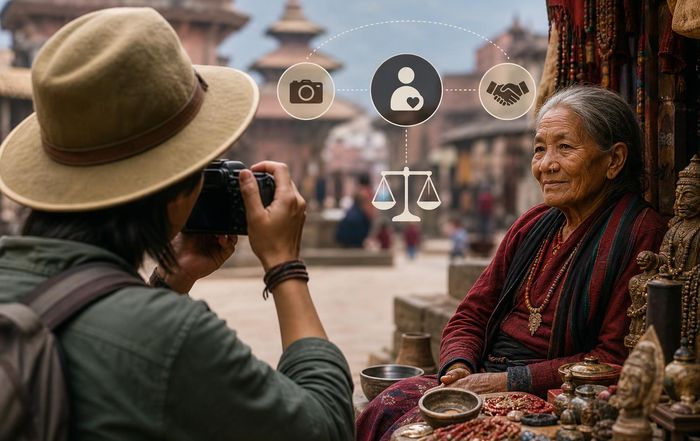
The Ethics of Photographing People While Traveling
In almost every major destination, from the markets of Marrakech to the streets of Tokyo, visitors can be seen raising cameras and phones toward strangers. Travel photography promises vivid memories and compelling stories, but it also raises difficult questions: Who has the right to someone's image? What counts as consent in a crowded street? When does "documenting culture" turn into exploitation or even harm? As cameras have become ever more discreet and powerful, and as social media amplifies those images to global audiences, the ethics of photographing people while traveling have become more complex and more urgent.
This page explores the ethical dimensions of photographing people in public and semi-public spaces around the world, with a focus on respect, consent, power, and cultural context. It also offers practical guidance for travelers who want to balance creative expression with human dignity, and points toward further resources across travel, culture, and ethics for readers who want to go deeper.
Why photographing people is ethically different from landscapes
Pointing a lens at a mountain or a skyline rarely raises ethical alarms; pointing it at a person is different. A landscape does not have privacy, social vulnerability, or cultural identity in the way a human being does. When a traveler photographs a person, they are not only capturing a visual scene but also freezing a moment of someone's life, often without knowing their circumstances, risks, or preferences. The image may travel far beyond the original context, especially when posted on platforms like Instagram or TikTok, and can be copied, manipulated, or used commercially long after the traveler has forgotten it.
Ethical concerns arise partly because of power imbalances. Visitors from wealthier countries often photograph residents in lower-income regions, framing them as "colorful" or "authentic" backdrops. This can reinforce stereotypes and a one-sided gaze reminiscent of colonial-era travel writing, where local people were observed and described but rarely given a voice. Organizations such as UNESCO and UNICEF have highlighted how images of children, marginalized communities, or people in crisis can shape global narratives, sometimes in ways that strip individuals of agency or dignity. Unlike a mountain, a person can feel objectified, misrepresented, or exposed by a photograph; the fact that the photographer may never see the consequences does not make those consequences less real.
The ethics become even more complicated when images touch on sensitive domains: health, religion, poverty, political protest, or intimate family life. A picture of a stranger praying, crying, or receiving medical care might feel like a powerful "travel moment" to the photographer, but to the subject it may be a deeply private or dangerous exposure. For readers interested in how images shape societal narratives, related discussions around representation and power are explored more broadly in sections of WorldsDoor devoted to culture, society, and world issues.
Legal rights vs. ethical responsibilities
Many travelers assume that if something is legal, it is automatically acceptable. In reality, photography law and photography ethics are only partially aligned, and the gap between them varies widely by country. In some jurisdictions, such as the United States and the United Kingdom, it is generally legal to photograph people in public spaces where there is no "reasonable expectation of privacy," though there are important exceptions involving harassment, commercial use, or sensitive locations. Civil liberties groups like the American Civil Liberties Union (ACLU) and organizations such as Liberty in the UK (libertyhumanrights.org.uk) provide guidance on photographers' rights, but they also stress that legality does not absolve one from acting responsibly.
Other countries have far stricter privacy laws. In much of continental Europe, data protection frameworks inspired by the General Data Protection Regulation (GDPR) emphasize personal control over one's image, and some jurisdictions treat identifiable photographs as personal data. France and Germany, for example, have traditions of personality rights that can limit publication or commercial use of images without consent. National data protection authorities, such as the European Data Protection Board (edpb.europa.eu), offer high-level guidance on how personal data-including images-should be handled, though everyday travel photography is not their primary focus.
Yet even where the law is permissive, ethical questions remain. A traveler may be legally entitled to photograph a street vendor or a child playing in a fountain, but if the subject is uncomfortable, lacks the means to object, or later faces ridicule or risk because of the image, the photographer has arguably failed in their responsibility. Ethical travel organizations and codes, such as those promoted by the Global Sustainable Tourism Council (gstcouncil.org) and UN Tourism (unwto.org), increasingly mention respectful photography as part of responsible visitor behavior, emphasizing consent, privacy, and non-exploitation alongside environmental and economic concerns.
Travelers who wish to navigate this landscape thoughtfully can benefit from understanding both the legal baseline and the higher ethical bar. WorldsDoor's sections on travel, ethics, and sustainable practices offer broader context on how rules, norms, and responsibilities intersect in tourism.
Consent: more than a quick nod
Consent is often treated as a simple yes/no question: "Can I take your photo?" But meaningful consent is more layered. It involves clarity about what is being requested, the ability to say no without pressure, and some understanding of how the image might be used. On a busy street, pointing to a camera and raising an eyebrow may elicit a smile, but that does not necessarily mean the person is comfortable being posted to hundreds or thousands of strangers online. Likewise, a nod from someone who does not share the photographer's language might reflect politeness, confusion, or perceived obligation rather than genuine willingness.
Ethical consent starts with slowing down. Instead of "stealing" a candid shot and walking away, a traveler can approach, greet the person in a respectful manner, and, where possible, use simple phrases in the local language to ask permission. Resources like Ethical Traveler (ethicaltraveler.org) and responsible tourism guidelines from Tourism Concern (historically archived by other NGOs) have long emphasized that the interaction matters as much as the image: a brief conversation, an explanation, or showing the subject the photo on the screen can transform an extractive moment into a shared one. When language barriers exist, tone, body language, and the option clearly to decline become even more important.
Power dynamics complicate consent. In low-income settings, people may feel compelled to agree because the photographer is a paying customer, a guest of a powerful institution, or simply a foreigner with more resources. This is especially acute with children, who cannot give informed consent on their own. Major child-protection organizations like UNICEF (unicef.org) and Save the Children (savethechildren.org) advise against sharing identifiable images of children without explicit permission from a parent or guardian and caution against any imagery that could expose children to stigma or harm. For travelers, this means resisting the temptation to photograph children just because they appear curious or playful; adults should be consulted, and even then, the nature and future use of the image should be considered carefully.
Another dimension of consent involves time. A person might agree to a photograph for a personal album but would object to its use in a blog, book, or advertising campaign. Professional photographers often use written model releases for commercial work, and guidance from organizations such as the American Society of Media Photographers (asmp.org) highlights why. While most casual travelers will not carry legal forms, they can still reflect on whether a given image is suitable only for private memories or for broader publication, and they can err on the side of caution when subjects might be identifiable in sensitive contexts.
Cultural and religious norms: context changes everything
Ethical photography cannot be separated from local norms, which vary widely across regions and communities. In some cultures, being photographed is considered flattering or neutral; in others, it is discouraged, restricted to specific circumstances, or associated with spiritual beliefs about the soul and representation. Religious spaces-mosques, temples, churches, shrines-often have explicit rules about photography, especially during services or rituals. Even where signs are absent, visitors may notice that locals refrain from taking pictures at certain moments, a subtle cue that the camera should stay down.
Travel advisories and cultural-etiquette guides from organizations such as Culture Crossing or official tourism boards can offer initial guidance, but they cannot cover every nuance. Observing what residents do, asking local guides, and paying attention to posted notices are crucial. In some countries, photographing security forces, government buildings, or infrastructure is restricted or can provoke suspicion; foreign ministries, such as the U.S. Department of State (state.gov) or the UK Foreign, Commonwealth & Development Office (gov.uk), often mention such sensitivities in travel advice. While these notices are framed in terms of legal safety, they also hint at broader local attitudes toward cameras and surveillance.
Gender norms can be particularly significant. In conservative societies, photographing women-especially without their explicit consent-can be deeply disrespectful or even dangerous for them if images circulate widely. Similarly, photographing people engaged in religious devotion, mourning, or other emotionally charged practices can be intrusive, even if no law forbids it. Ethical travelers learn to distinguish between a public space and a public moment: not every visible event is fair game for documentation. For those exploring how culture and belief systems shape everyday behavior, the culture and religion- and ethics-adjacent coverage on WorldsDoor provides broader context beyond photography alone.
Finally, it is important to recognize that "local culture" is not monolithic. Younger urban residents may be comfortable with selfies and social media, while older or rural communities may be far more reserved. Assuming that everyone in a destination shares the same attitudes risks flattening complex societies into simple stereotypes. A more ethical approach is to treat each interaction as individual, guided by local norms but not reduced to them, and to default to caution where uncertainty remains.
Poverty, crisis, and the problem of "human scenery"
One of the most criticized forms of travel photography involves images of poverty, disaster, or illness-what critics often label "poverty porn." These photographs usually frame people in vulnerable conditions as objects of pity or curiosity, rather than as full human beings with agency and complexity. While photojournalists and humanitarian organizations sometimes need to document hardship to spur action, even they have developed codes of conduct to minimize harm and avoid exploitation. For casual travelers, the ethical bar is arguably higher: there is rarely a compelling public-interest justification for posting a stranger's suffering to social media.
Humanitarian bodies such as the International Committee of the Red Cross (icrc.org) and major NGOs have internal image guidelines that stress respect, dignity, and the avoidance of sensationalism. They caution against images that strip people of context, reducing them to anonymous victims or backdrops for a volunteer's self-presentation. When travelers wander through informal settlements, refugee camps, or disaster-affected areas with cameras raised, they risk turning complex human crises into visual souvenirs. Even when individuals smile or pose, the structural power imbalance-between someone living through hardship and someone who can leave at any time-makes consent ethically fragile.
An alternative approach focuses on listening and relationship before photography. If a traveler is volunteering or working with a local organization, they should follow that organization's media policies, which often prohibit individual volunteers from sharing identifiable images without oversight. If they are merely passing through, the most ethical decision may be not to photograph at all, or to take only wide, non-identifiable shots that convey context without singling out individuals. WorldsDoor's coverage of environment, world, and society issues frequently touches on the broader dynamics of representation in crisis, offering readers a wider lens through which to evaluate when an image informs and when it exploits.
The same caution applies to health settings. Hospitals, clinics, and traditional healing spaces involve sensitive personal information; photographing patients or practitioners without explicit, informed consent can breach not only ethical norms but also privacy laws in many countries. Public-health authorities such as the World Health Organization (who.int) emphasize confidentiality as a cornerstone of medical ethics, and images are part of that. A traveler who encounters a vaccination campaign or mobile clinic might find the scene visually striking, but that does not grant a right to broadcast identifiable faces or medical conditions to the world.
Children and vulnerable people: a higher duty of care
Photographing children raises distinct ethical and safety concerns. Children are less able to understand the implications of being photographed and have limited power to refuse. They are also more vulnerable to exploitation, bullying, or other harm if images circulate widely. As noted earlier, organizations like UNICEF and Save the Children have developed strict internal guidelines for the use of children's images, emphasizing that children should be shown with dignity, never in degrading or sexualized ways, and that identifiable images should not be shared without informed consent from a parent or legal guardian. These principles, while designed for professional contexts, are highly relevant to everyday travelers.
In many destinations, children may run toward visitors with cameras, eager to see their own faces on screens. While this can feel joyful, it can also normalize a dynamic in which children see themselves as entertainment for tourists. In some regions, children are encouraged by adults to pose for photos in exchange for money or gifts, intertwining photography with forms of child labor and dependency. Responsible-tourism advocates and child-protection experts, including coalitions such as ECPAT International (ecpat.org), warn against giving money directly to children or encouraging practices that keep them out of school or expose them to risk.
A cautious, child-centered approach might include avoiding close-up, identifiable images of children altogether unless there is a clear, ethically justified reason and proper consent; choosing angles that do not reveal faces; or focusing on hands, activities, or environments rather than individual identities. Travelers can also reflect on whether they would be comfortable with strangers taking and sharing similar images of children in their own communities. If the answer is no, that discrepancy often reveals an underlying double standard shaped by race, class, or geography.
Other vulnerable groups-people with disabilities, those experiencing homelessness, individuals engaged in stigmatized work, or members of persecuted minorities-deserve similar or even greater care. A single photograph uploaded to a global platform can inadvertently out someone's identity or circumstances, with consequences that the photographer never sees. Ethical travel photography, therefore, is not simply about politeness; it is about recognizing how images intersect with power, prejudice, and risk.
Social media, data trails, and the afterlife of images
In previous eras, travel photos lived primarily in physical albums or slideshows among friends. Today, images are often uploaded instantly to platforms run by large technology companies, where they may be analyzed by algorithms, used to train facial-recognition systems, or scraped into datasets without the knowledge of either photographer or subject. Technology-policy organizations like the Electronic Frontier Foundation (eff.org) and digital-rights groups have raised concerns about how ubiquitous photography feeds surveillance infrastructures and erodes practical privacy, especially for those who are already heavily monitored.
For travelers, this means that pressing "share" is not a neutral act. A portrait taken in a market in Nairobi or a street in Bangkok may become part of a vast, machine-readable archive of faces, linked to location data and other metadata embedded in the file. Even if the photographer intends only to share with friends, platform settings can change, accounts can be hacked, and images can be downloaded and reused elsewhere. Ethical considerations thus extend beyond the moment of capture to the long-term digital life of the photograph.
Practical steps can mitigate some of these risks. Turning off automatic geotagging for sensitive images, using privacy-restricted sharing settings, and avoiding hashtags that expose individuals or communities to unwanted attention are small but meaningful measures. Some travelers choose to keep portraits of strangers offline altogether, using them only for personal reflection or physical prints. Others anonymize images by avoiding clear faces or distinctive details that could enable identification. WorldsDoor's coverage of technology and innovation often explores how digital tools reshape travel, culture, and ethics, offering broader context for readers who want to understand the systems into which their images flow.
The commercial dimension of social media also matters. Influencers and content creators may derive income, sponsorship, or professional recognition from images of people who never consented to be part of a brand narrative. When a traveler's feed doubles as a marketing channel, the ethical obligation to secure consent and avoid exploitation becomes even stronger, edging closer to the standards expected of professional photographers and media organizations.
Practical guidelines for more ethical travel photography
Translating ethical reflection into everyday practice can be challenging, especially in fast-moving environments. However, certain principles can help travelers navigate most situations with greater care and respect, while still leaving room for creativity and spontaneity.
First, adopt a people-first mindset. Before raising the camera, ask whether the image treats the subject as a full person rather than a prop. Consider their likely feelings if they saw the photo online, recognized themselves, and understood how it was being discussed. If the framing emphasizes dignity, agency, and context, it is more likely to align with ethical standards; if it emphasizes shock, pity, or exoticism, it may be time to reconsider. This mindset aligns with broader responsible-travel frameworks that treat local communities as partners rather than scenery-a theme that recurs across WorldsDoor's travel, lifestyle, and business coverage of tourism.
Second, normalize asking-and accepting no. Whenever feasible, seek explicit permission, using words, gestures, or the help of a guide or interpreter. If someone declines, do not try to sneak a candid shot afterward or pressure them to change their mind. Respecting refusals builds trust not only for the individual interaction but also for how future visitors are perceived. In group settings, remember that one person's enthusiastic yes does not automatically extend to everyone in the frame; adjust your composition accordingly.
Third, be especially cautious with children and vulnerable people. Avoid posting identifiable images of children without verifiable guardian consent, and err on the side of non-identifiability when photographing vulnerable communities. Ask yourself whether the image is necessary at all, or whether a written description, wide-angle scene, or memory might serve the story just as well without exposing individuals. This approach mirrors the protective stance recommended by child-rights organizations and health-ethics bodies worldwide.
Fourth, pay attention to setting and moment. Religious ceremonies, funerals, medical situations, and scenes of visible distress generally call for putting the camera away unless you are working in a professional capacity with clear ethical guidelines and community consent. Even in more everyday contexts, such as markets or public squares, look for cues from locals about when photography feels welcome and when it feels intrusive. If a space has clear "no photos" signs, respect them; if rules are unclear, ask.
Finally, think before you share. Review your images with a critical eye before uploading them. Remove or blur faces when necessary, avoid captions that stereotype or demean, and consider whether the subject might be identifiable not only by their face but also by clothing, location, or companions. If you maintain a blog, channel, or portfolio, consider writing your own short ethical policy for photography and sticking to it; articulating your standards publicly can help keep you accountable and may influence others to reflect on their practices.
Rethinking what it means to "bring home" a place
At the heart of ethical travel photography lies a broader question: What does it mean to capture and share a place? For generations, travelers have used images to show others where they have been and what they have seen. But the ease of digital photography and the attention economy of social media have tilted that impulse toward quantity and spectacle, sometimes at the expense of the people whose lives form the backdrop of those images. Rebalancing this dynamic requires more than a few rules; it calls for a shift in how travelers conceive of their role.
Instead of treating photography as an act of taking, it can be framed as an act of relationship. This might mean fewer images but deeper encounters: talking with someone before or after a portrait, learning their name with permission, or even sending them a copy of the photo if they wish. It might mean focusing more on the built environment, landscapes, and personal reflections, and less on anonymous faces. It might also mean accepting that some of the most powerful travel experiences are precisely the ones that cannot be ethically photographed and must instead be carried home in memory or words.
Ethical photography does not demand perfection or paralysis; mistakes will happen, and norms will continue to evolve as technology and societies change. What it does demand is attentiveness: to power, to consent, to culture, to the long life of digital images, and above all to the humanity of the people on the other side of the lens. By approaching photography with this attentiveness, travelers can continue to document the world's diversity while honoring the dignity of the people who inhabit it.