

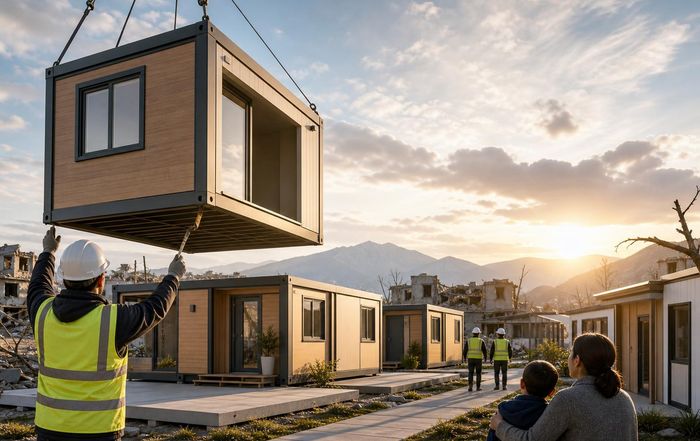
How Modular Housing Could Transform Disaster Recovery
When a major storm, earthquake, wildfire, or flood hits, housing is often the first visible casualty and the last element fully restored. Families can spend months or years in temporary shelters, hotels, or improvised structures while conventional rebuilding struggles through damaged supply chains, labor shortages, and complex permitting. Against this backdrop, modular housing has moved from niche curiosity to serious candidate for reshaping how communities respond to and recover from disasters.
Modular housing-factory-built units transported to a site and assembled into complete homes or buildings-offers speed, predictability, and potential cost savings compared with traditional construction. Yet its role in disaster recovery is neither simple nor guaranteed. It sits at the intersection of housing policy, emergency management, community planning, and technology. Understanding its promise and limits is crucial as climate change drives more frequent and severe disasters worldwide.
This top article examines how modular housing works, why it appeals to emergency planners, where it has succeeded and struggled, and how governments and communities could integrate it more intelligently into future recovery efforts.
What Modular Housing Actually Is (and Isn't)
Modular housing differs from both traditional site-built homes and simple temporary shelters. In modular construction, much of the building-sometimes 80-90 percent-is manufactured in a controlled factory environment as volumetric modules or large panels. These modules include structural components, insulation, plumbing, and often finishes and fixtures. Once complete, they are transported by truck, rail, or ship and assembled on prepared foundations.
This is distinct from manufactured homes (often called "mobile homes" in North America) built to separate standards such as the HUD Code in the United States, and from emergency tents or basic prefabricated shelters used immediately after disasters. Modern modular units can range from compact studios to multi-bedroom family homes and multi-story apartment blocks, often meeting the same building codes as conventional housing. Organizations such as Modular Building Institute and research from universities including MIT and TU Delft have documented how factory production can improve quality control and reduce waste compared with traditional construction.
In disaster contexts, modular housing can serve different roles along the recovery timeline: as upgraded temporary shelters replacing tents or trailers; as "interim" housing that may later be moved or repurposed; or as permanent homes installed quickly to replace destroyed housing stock. The flexibility of modular systems-reconfigurable layouts, stackable units, and demountable foundations-underpins their appeal for emergency use but also complicates regulation and planning.
For readers interested in how modular solutions intersect with broader questions of sustainability and urban development, our coverage of sustainable and innovation topics explores related trends in green construction and resilient cities.
Why Speed Matters: The Case for Factory-Built Recovery
After a major disaster, the clock starts ticking on human, social, and economic costs. Extended displacement is linked to worse health outcomes, educational disruption, and long-term poverty. Agencies such as the World Health Organization have highlighted how unstable housing and overcrowded shelters can exacerbate disease spread, mental health challenges, and vulnerability for children and older adults. Similarly, the World Bank has documented how slow reconstruction deepens economic losses by delaying people's return to work and normal life.
Modular housing offers one of the few realistic ways to compress the timeline between destruction and reoccupation of safe dwellings. Because units are produced in factories that may be far from the disaster zone, manufacturing can start even while debris is being cleared and infrastructure repaired locally. This parallel processing contrasts with conventional rebuilding, which must wait for on-site conditions to stabilize and for local labor and material supplies to recover-often a slow process when roads, ports, and supply chains are damaged.
In practice, modular production lines can be scaled up quickly, with standardized designs and repeatable processes. Large manufacturers in countries such as Japan, Germany, and the United States have demonstrated the ability to turn out hundreds or thousands of units on relatively short notice, as seen after the 2011 Tōhoku earthquake and tsunami and in various post-hurricane efforts in North America. The United Nations Office for Disaster Risk Reduction and other agencies increasingly reference industrialized construction as part of resilient recovery strategies.
At the same time, speed alone is not enough. Poorly planned modular deployments can produce "temporary" camps that become semi-permanent, socially isolated enclaves, echoing criticisms of post-Katrina trailers in the United States or post-earthquake camps in parts of Italy and Turkey. To avoid these pitfalls, modular programs must be integrated into broader society and world planning frameworks, not treated as stand-alone technical fixes.
From Tents to Transitional Neighborhoods: Where Modular Fits in the Disaster Timeline
Disaster response is often described in phases: immediate relief, early recovery, and long-term reconstruction. Modular housing can play a role in each, but its strengths are clearest in the transition from emergency shelter to stable, dignified living conditions.
In the immediate aftermath-days to a few weeks-rapidly deployable tents, school gyms, and ad hoc shelters remain the default. Modular units are generally too heavy and logistically complex for the very first hours of crisis. However, within weeks, as needs stabilize and sites are identified, modular systems can replace crowded shelters with self-contained units featuring private bathrooms, cooking facilities, and better thermal performance. Agencies such as the International Federation of Red Cross and Red Crescent Societies and the UN Refugee Agency (UNHCR) have experimented with modular-like shelter systems that can be upgraded over time, blurring the line between emergency and transitional housing.
In the medium term-months to a few years-modular housing can be configured into small neighborhoods with shared spaces, schools, clinics, and shops. This approach was used, with mixed results, in post-tsunami Japan, where modular estates allowed communities to remain near their original locations, and in several European countries responding to flood and wildfire displacement. The key distinction from earlier generations of trailers or barracks is the potential for better design: more daylight, improved acoustics, energy-efficient envelopes, and thoughtful layouts that support privacy and social interaction.
In the long term, modular units can either be relocated, repurposed (for student housing, migrant accommodation, or social housing), or left in place as permanent homes if they meet local codes. Countries such as Sweden and Netherlands have explored modular housing both for disaster response and to address chronic housing shortages, suggesting a pathway where investments made under emergency conditions continue delivering value for decades. Our world and business coverage often returns to this question of how crisis-driven infrastructure can be integrated into longer-term urban strategies.
Design for Dignity: Health, Culture, and Social Cohesion
Housing after disaster is not just about a roof and four walls. Public health experts and sociologists emphasize that the quality and cultural suitability of post-disaster housing significantly affect recovery. Overcrowded or poorly ventilated shelters increase respiratory disease and stress; lack of privacy can heighten gender-based violence risks; and relocation far from original neighborhoods can sever social networks that are vital for emotional resilience.
Modular housing, when thoughtfully designed, can help address these issues. Units can be configured to support different household sizes and cultural norms-separate spaces for extended families, gender-sensitive layouts, or areas for religious practice. The World Health Organization and national health agencies in countries like Canada and Australia have published guidance on healthy housing, emphasizing ventilation, thermal comfort, and indoor air quality, all of which can be more easily controlled in factory-built systems than in improvised or rapidly site-built structures.
From a cultural perspective, modular villages can be arranged to mirror pre-disaster street patterns or social groupings, preserving a sense of place even when people cannot immediately return to their original homes. This stands in contrast to many past examples where displaced residents were moved to distant, homogeneous estates with little connection to their previous lives. Integrating community spaces, schools, and clinics into modular developments is critical, linking housing to education, health, and culture rather than treating it in isolation.
Still, modular solutions can also fail on these fronts if driven solely by procurement efficiency. Standardized units imported without adaptation to local customs or climate may feel alien or unsuitable, undermining acceptance and leading to underuse or abandonment. Disaster recovery agencies increasingly recognize the need for participatory design, engaging affected communities in layout decisions and interior configurations, even when time pressure is intense.
Environmental and Climate Considerations: Building Back Greener
As climate-related disasters intensify, the environmental footprint of recovery itself has come under scrutiny. Traditional reconstruction often involves significant waste, carbon-intensive cement and steel, and ad hoc rebuilding in high-risk locations. Modular housing offers opportunities to reduce some of these impacts, though outcomes depend heavily on design choices, materials, and logistics.
Factory production can reduce material waste through more precise cutting, standardized components, and better reuse of offcuts. Studies cited by organizations such as the World Green Building Council and national green building councils have found notable reductions in waste and potential energy savings across the life cycle of modular buildings compared with typical site-built equivalents. Units can be designed for disassembly, allowing components to be reused or recycled rather than demolished and landfilled after their first use.
Energy performance is another advantage: modular envelopes can be tightly controlled for insulation and air sealing, supporting low-energy or even net-zero designs. This is especially relevant when displaced communities face extreme heat or cold, and when local power grids are damaged or unstable. Coupling modular housing with rooftop solar, battery storage, and efficient appliances aligns with broader climate-resilient infrastructure goals promoted by organizations like the International Energy Agency and UN Environment Programme.
However, modular housing is not inherently sustainable. Transporting heavy modules over long distances can generate substantial emissions, and the widespread use of certain foams or plastics can raise concerns about embodied carbon and end-of-life disposal. If modular deployments encourage rebuilding in highly exposed areas without adequate risk reduction-such as floodplains or fire-prone hillsides-the long-term environmental and social costs may outweigh initial efficiencies. Integrating modular strategies into comprehensive environment and sustainable planning is therefore essential.
Policy, Regulation, and the Reality of Implementation
The promise of modular housing often collides with regulatory and institutional realities. Building codes, land-use rules, procurement policies, and financing mechanisms were largely developed around conventional construction. In many jurisdictions, there is still confusion over how to classify modular units: as permanent buildings, temporary structures, manufactured homes, or something else entirely. This ambiguity can delay approvals at precisely the moment when speed is most needed.
National and local governments, often advised by bodies such as the OECD and UN-Habitat, have begun revising regulations to accommodate industrialized construction, including modular methods. Some countries have introduced fast-track approvals for pre-certified modular designs that meet defined safety and performance standards. Others are experimenting with pre-arranged land banks and zoning overlays that can be activated after a disaster to host modular neighborhoods without lengthy planning disputes.
Financing is another barrier. Disaster relief funds are typically structured around short-term emergency expenditure or long-term reconstruction, with less clarity on how to pay for transitional modular housing that may later be moved or repurposed. Development banks and international donors are exploring models where modular assets are financed as long-lived infrastructure rather than disposable emergency costs, but accounting rules and political expectations often lag behind.
Procurement processes can also be cumbersome. Competitive bidding requirements, anti-corruption safeguards, and local content rules are important for accountability but can slow down contracting in the middle of a crisis. Governments that have successfully used modular housing for recovery often invest in pre-disaster framework agreements with qualified suppliers, including clear technical specifications and pricing structures, so that orders can be placed quickly when needed. This kind of anticipatory planning aligns with the "build back better" principles promoted in the Sendai Framework for Disaster Risk Reduction.
Community Acceptance, Equity, and the Risk of Two-Tier Recovery
Even when modular housing is available and technically sound, community acceptance is not guaranteed. Many people associate factory-built housing with lower quality or stigma, often based on earlier generations of mobile homes or temporary barracks. If modular units are deployed only for lower-income or marginalized groups, they can reinforce perceptions of a two-tier recovery, where wealthier households rebuild conventional homes while others are relegated to "boxes."
Addressing this requires more than public relations. Authorities and aid agencies must ensure that modular solutions meet or exceed basic standards for space, durability, and comfort, and that they are distributed equitably. Transparent criteria for who receives modular housing, how long they can stay, and what pathways exist to permanent tenure are essential to avoid resentment and speculation. In some European and Asian examples, modular housing has been integrated into mixed-income developments or university-style campuses, normalizing its use and reducing stigma.
Design quality plays a major role in perception. Thoughtful architecture, green spaces, and community facilities can make modular neighborhoods feel like real places rather than temporary camps. Integrating local materials, colors, and cultural elements helps avoid the sense of imported "containers" dropped into unfamiliar landscapes. Our lifestyle and culture coverage frequently highlights how design influences social cohesion, and post-disaster modular projects are no exception.
Equity considerations also extend to who benefits economically from modular deployments. Local construction workers and small contractors may fear displacement by large factory producers, especially if modules are imported from other regions or countries. Hybrid models, where local firms handle foundations, assembly, and finishing while factories supply core modules, can distribute benefits more widely and preserve local skills.
Technology, Data, and the Future of Modular Disaster Recovery
Advances in digital design, manufacturing, and logistics are reshaping what modular housing can do in disaster contexts. Building information modeling (BIM), parametric design tools, and digital twins allow planners to generate multiple layout options quickly, simulate crowding and traffic flows, and optimize for sunlight, ventilation, or evacuation routes. Robotics and automation in factories can improve precision and speed, while reducing exposure of workers to hazardous materials.
On the logistics side, better data on transport networks and real-time conditions-drawn from satellite imagery, drones, and sensor networks-can help route modules efficiently into damaged areas. Organizations such as NASA and the European Space Agency have supported Earth observation programs that inform post-disaster planning, including identification of safe sites for temporary settlements. Meanwhile, humanitarian innovation labs and research centers are testing modular concepts that integrate water purification, off-grid energy, and digital connectivity directly into housing units.
These technologies also raise governance and ethics questions. Who owns the data used to plan modular settlements? How are privacy and consent handled when digital tools track displaced populations? And how can innovation be steered toward genuine needs rather than showcase projects? International bodies like UN OCHA and major NGOs are beginning to develop guidelines for responsible use of emerging technologies in humanitarian settings, but practice is still evolving.
In parallel, the broader construction technology sector-often called "contech"-is seeing increased investment from both public and private actors. Venture-backed modular startups, established construction firms, and housing authorities are experimenting with business models that blend disaster response, affordable housing, and urban regeneration. As these ecosystems mature, modular capacity available during crises may grow, provided economic cycles and market consolidation do not erode diversity and resilience in the supply base.
Making Modular Housing a Smarter Part of Recovery?
Modular housing is not a silver bullet for disaster recovery, but it can be a powerful tool when integrated with thoughtful planning, robust governance, and community engagement. Its potential lies less in isolated pilot projects and more in how it can reshape systems: accelerating safe rehousing, reducing the environmental footprint of reconstruction, preserving social networks, and enabling more flexible responses as climate risks evolve.
For policymakers and practitioners, several priorities stand out. First, invest in pre-disaster planning: land identification, streamlined approvals, pre-qualified suppliers, and clear standards for modular units that can serve both transitional and permanent roles. Second, embed health, culture, and equity considerations from the start, drawing on guidance from health agencies, local communities, and social scientists. Third, align modular deployments with broader strategies for resilient infrastructure, sustainable urban development, and climate adaptation, rather than treating them as one-off emergency purchases.
For observers interested in how societies adapt to a more volatile world, modular housing is a revealing case study. It sits at the crossroads of technology, environment, society, and business, showing how industrial innovation can either entrench old patterns of inequality or help build fairer, more resilient communities. The choices made before and after the next disaster will determine which path prevails.