

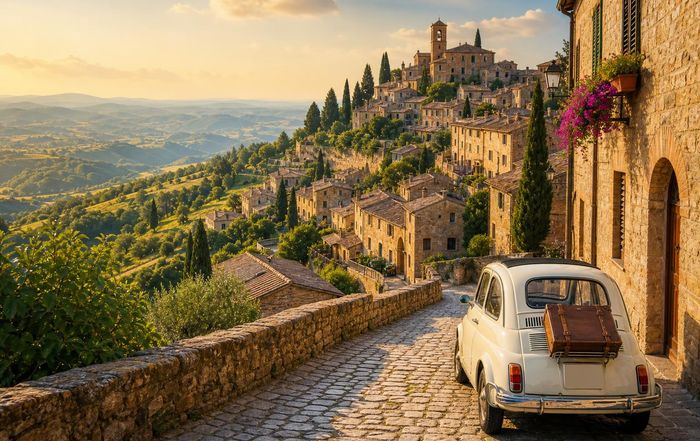
Slow Travel Routes Through Italy's Historic Hill Towns
Italy's hill towns were not built for speed. Perched on ridgelines and volcanic tuffs, encircled by medieval walls and vineyards, they reward travelers who are willing to walk rather than rush, to linger over a coffee instead of sprinting for the next checklist sight. Slow travel here is less about seeing everything and more about letting a few places unfold in detail: their rhythms, food, dialects, and landscapes.
Now we will outline several slow travel routes through some of Italy's most evocative hill town regions-Tuscany, Umbria, Le Marche, Piedmont, and Sicily-along with practical advice for moving between them at a human pace. It is designed for travelers who want to combine cultural depth, landscape, and local food rather than chase major tourist hubs.
Why Hill Towns Are Ideal for Slow Travel
Italy's historic hill towns grew up around defensive needs, religious routes, and agricultural life. Many still retain compact historic centers, limited car access, and walkable streets, making them natural environments for unhurried exploration. Trains and regional buses reach many of the surrounding valleys, but the last stretch is often on foot or by local shuttle. That small friction-needing to climb a slope, wait for a bus, or time your day around a market-can become an asset for slow travelers, encouraging longer stays and deeper engagement.
From a cultural perspective, these towns preserve layers of Etruscan, Roman, medieval, and Renaissance history in a scale that is digestible in a day yet rewarding over a week. A visitor can get to know a place's bakery, the evening passeggiata, the family-run bar, and perhaps a local festival, rather than skimming past monuments. For those interested in broader cultural context, Italy's hill towns also offer a good counterbalance to the country's big cities and coastal hotspots often covered in mainstream travel media.
For planning, national and regional tourism sites such as Italia.it, ENIT (the Italian National Tourist Board), and individual regional portals provide up-to-date information on transport, walking paths, and events. For maps and trails, the Club Alpino Italiano (CAI) and local hiking associations are also helpful, especially if you plan to link hill towns on foot.
Tuscany: Beyond the Crowds in the Val d'Orcia and Chianti
Tuscany's countryside is heavily photographed, but much of it remains surprisingly quiet once you step away from major bus routes. Two areas in particular lend themselves to slow hill-town itineraries: the Val d'Orcia, south of Siena, and the hills between Siena and Florence, often grouped under the Chianti label.
A classic slow route in the Val d'Orcia might begin in Pienza, a Renaissance "ideal city" overlooking a soft, rolling landscape. From here, travelers can spend several days visiting nearby Monticchiello, San Quirico d'Orcia, Bagno Vignoni, and Montalcino, moving mostly by local bus, bicycle, or on foot. Pienza and San Quirico are connected by segments of the historic Via Francigena pilgrimage route, now waymarked for walkers; the official route information is available from the European Association of the Via Francigena. Slow travelers often choose a base in one town for three or four nights and explore the others as day trips, returning to the same guesthouse and café, which quickly creates a sense of familiarity.
In Chianti, a gentler but still hilly landscape links Castellina in Chianti, Radda in Chianti, and Gaiole in Chianti, among others. While the area is known for wine estates, the small stone towns themselves are compact and walkable, with weekly markets and simple trattorie. Bus connections from Siena and Florence make it possible to visit without a car, though travel times can be longer than driving. For those interested in sustainable mobility, regional information from Regione Toscana and national rail operator Trenitalia can help piece together train-plus-bus combinations that keep car use to a minimum.
Tuscany's hill towns pair naturally with broader interests in culture and food, from pecorino cheese in Pienza to Brunello wines around Montalcino. Travelers keen on the environmental footprint of their journeys may also appreciate that staying longer in one base, walking between villages, and using public transport where possible align with many of the principles highlighted in sustainable travel discussions on sites like UNWTO and UNEP. Readers who want to explore sustainability more broadly can find related perspectives on environment and sustainable travel within our own coverage.
Umbria: A String of Hill Towns from Assisi to Orvieto
Neighboring Umbria offers a dense concentration of hill towns within relatively short distances, making it particularly suitable for multi-day slow routes. The region is sometimes called the "green heart of Italy," and its mix of forested hills and stone towns can feel calmer than Tuscany's more visited landscapes.
One well-connected axis runs from Perugia to Assisi, Spello, Foligno, and Spoleto, all served by regional trains. From these towns, buses link up to smaller hilltop centers such as Trevi, Montefalco, and Bevagna. A slow traveler might, for example, base in Spello for several nights, walking down to the valley stations for trains or using local buses to reach neighboring towns, then shifting base to Spoleto for a few more days. Many of these towns have historic centers closed to through traffic, encouraging walking and making evenings particularly peaceful.
Further south, Orvieto rises dramatically on a volcanic tuff cliff, with its cathedral façade visible from the surrounding valley. The town is directly on the main Florence-Rome rail line, making it a natural entry or exit point for a hill-town-focused journey. A funicular connects the train station to the historic center, and from Orvieto travelers can take buses to nearby villages and wine areas. The Regione Umbria transport portal and Trenitalia provide timetables, though schedules can change seasonally, so it is wise to confirm times shortly before travel.
For walkers, Umbria is crossed by several long-distance routes, including the Via di Francesco, which connects places associated with St Francis between La Verna, Assisi, and Rome. The Italian National Tourist Board and regional tourism sites offer overviews of these routes, with links to local organizations that maintain trails. Pilgrimage paths naturally lend themselves to slow travel, with daily stages between towns that rarely exceed 20-25 kilometers and accommodation options ranging from simple pilgrim hostels to agriturismi.
Umbria also offers a lens on Italian society beyond the big cities-small-scale family agriculture, local religious festivals, and the tension between heritage preservation and modern life. Readers interested in these broader social dynamics may find useful context in our sections on culture, society, and world, where similar themes emerge in other countries' rural regions.
Le Marche: Adriatic Slopes and Quiet Stone Towns
Moving east, Le Marche remains less internationally known than Tuscany or Umbria, yet it hosts a remarkable chain of hill towns rising from the Adriatic coast into the Apennines. The relative lack of mass tourism here makes it attractive for travelers seeking quieter experiences without sacrificing historic character.
A slow route might begin in the coastal city of Ancona or the university town of Urbino, then move through smaller centers such as Cagli, Urbania, Arcevia, and Corinaldo. Many of these towns sit on ridges with sweeping views and well-preserved walls. Regional buses and, in some cases, local trains connect them, though frequencies can be limited, encouraging longer stays in each town. The Regione Marche website and local tourism offices provide current information on routes and seasonal changes.
Further south, the area around Ascoli Piceno and Offida combines vineyards, olive groves, and hilltop villages that can be linked on foot or by bicycle. While the terrain is hilly, distances between settlements are often modest, making it feasible for reasonably fit travelers to design multi-day walking loops. Organizations such as CAI and local hiking clubs maintain marked trails; their resources are especially useful for those venturing into the foothills of the Monti Sibillini.
Le Marche's hill towns also provide insight into economic shifts in less urban parts of Italy-population aging, the impact of earthquakes in the central Apennines, and the role of small manufacturing and agriculture. For broader economic context, readers may find it useful to consult analyses by organizations such as the OECD and ISTAT, Italy's national statistics institute, which track demographic and regional development trends that shape life in these communities.
Piedmont and the Langhe: Vineyards, Truffles, and Nebbia
In northwest Italy, Piedmont offers a different kind of hill-town landscape, particularly in the Langhe, Roero, and Monferrato areas south of Turin. Here, vineyards and hazelnut groves wrap around ridges topped with compact towns like La Morra, Barolo, Neive, and Barbaresco. Morning fog (nebbia) often settles into the valleys, giving the region a distinctive autumn atmosphere that slow travelers may find particularly appealing.
A common approach is to base in a mid-size town such as Alba or Asti, both reachable by train, and then explore surrounding hill towns by bus, bicycle, or organized shuttle. While many visitors come for wine and truffles, staying multiple days allows time to walk between villages on country lanes, visit small producers, and observe how wine tourism intersects with local life. Regional transport information is available through Regione Piemonte, while Trenitalia covers rail access from Turin, Milan, and Genoa.
The Langhe and Monferrato have been recognized as a UNESCO World Heritage cultural landscape, with UNESCO's main site at unesco.org providing an overview of why the region's vineyard hills are considered of outstanding universal value. For slow travelers, this designation often translates into well-maintained viewpoints, interpretive trails, and local initiatives to support more sustainable tourism. Those interested in how tourism, food systems, and rural economies intersect may also find useful background in reports by the Food and Agriculture Organization, which looks at Mediterranean agricultural landscapes more broadly.
Because the area is strongly tied to wine and gastronomy, it can be tempting to rush from tasting to tasting. A slow-travel mindset might instead prioritize fewer visits, more time on foot or by bike, and at least one day without scheduled activities, simply wandering the streets of a town like Neive or Monforte d'Alba and watching daily routines. For readers who want to connect these experiences with wider lifestyle choices-such as moderate consumption, walking-based fitness, or seasonal eating-our lifestyle and food sections explore similar themes in other contexts.
Sicily's Hill Towns: Inland Routes Beyond the Coast
Sicily is often associated with its coastline and major cities, but its interior hosts a network of hill towns that feel far removed from the island's busier resort areas. Traveling slowly here involves more logistical planning-public transport can be sparse-but the reward is a window onto communities that have changed more slowly than the island's coastal hubs.
An inland route might link Enna, sometimes called the "navel of Sicily" due to its central location and elevation, with towns such as Piazza Armerina, Aidone, and Caltagirone. Enna and Caltagirone are accessible by train, while buses connect to smaller towns. Piazza Armerina is known for the nearby Villa Romana del Casale, a UNESCO-listed Roman villa with exceptional mosaics, though the town itself, with its lanes and viewpoints, merits time in its own right. As elsewhere in Italy, timetables are best checked close to travel dates via regional operators and national rail sites.
Further west, areas around Caltabellotta, Sambuca di Sicilia, and Caccamo offer dramatic hilltop settings with fewer international visitors. Some of these towns have been involved in "1-euro house" schemes designed to counter depopulation, a phenomenon covered by international media and analyzed in broader demographic studies by organizations like Eurostat. For slow travelers, such initiatives can be a reminder that these are living communities facing real economic challenges, not open-air museums.
Because inland Sicily can be hot in summer, shoulder seasons-spring and autumn-are often more comfortable for walking between towns and spending time outdoors. Travelers with an interest in health and heat adaptation may find practical guidance from organizations such as the World Health Organization, which publishes advice on coping with higher temperatures, relevant both for locals and visitors. On our own health pages, we also explore how climate and travel intersect more generally.
Planning a Slow Hill-Town Journey: Transport, Timing, and Pace
Designing a slow route through Italy's hill towns involves balancing ambition with realistic travel times. Trains form the backbone of most itineraries, linking major and mid-size towns. From there, regional buses, local shuttles, and walking paths connect to smaller hilltop centers. Trenitalia covers most of the national rail network, while some regions also have private operators such as Italo for high-speed routes between large cities; these can be useful for repositioning before or after a slower segment.
Once in a region, travelers who wish to minimize driving can use regional transport portals (for example, those of Regione Toscana, Regione Umbria, or Regione Piemonte) as starting points. These sites typically link to bus companies, publish route maps, and indicate whether certain lines operate only on school days or weekdays. Because schedules in rural areas can be thin, a slow-travel approach benefits from flexibility: staying longer in one base, accepting occasional long midday breaks, and planning walking segments where feasible.
Walking itself can be a primary mode of moving between hill towns, especially along established routes such as the Via Francigena, the Via di Francesco, or local networks of footpaths. The Club Alpino Italiano and regional parks often provide trail information, while broader European walking organizations offer guidance on multi-day routes. Even when not following a named trail, using topographic maps and local advice can reveal old mule tracks and farm lanes that link villages without needing to walk on busy roads.
For those concerned about the environmental impact of their journeys, slow hill-town routes naturally align with many sustainable travel principles: fewer flights, longer stays, more walking and public transport, and a focus on local food. International bodies such as the UN World Tourism Organization and UNEP publish frameworks and case studies on how tourism can support rural communities while reducing negative impacts. Readers interested in these broader questions may also want to explore our coverage of innovation, where initiatives in sustainable mobility and rural development often intersect with travel.
Cultural Etiquette and Everyday Rhythms
Slow travel in hill towns is as much about how one behaves as where one goes. These are small communities where regular patterns-school runs, market days, religious processions-shape the public space. Visitors who stay several days in a town quickly notice the morning coffee rush at the bar, the lull after lunch, and the evening passeggiata when residents stroll through the main street or piazza.
Basic Italian phrases and a willingness to adapt to local timetables go a long way. Shops may close for several hours at midday, especially in smaller or hotter locations, and restaurants may only open for dinner after 19:30 or 20:00. Rather than seeing these rhythms as inconveniences, slow travelers often use them as invitations to rest, read, or simply sit in a square and observe. This kind of unstructured time can be as memorable as formal sightseeing.
Respect for local customs also extends to dress and behavior in religious spaces, especially in towns where churches are active centers of community life rather than purely touristic sites. Guidance from cultural institutions and ministries, such as Italy's Ministero della Cultura (reachable via cultura.gov.it), often emphasizes modest clothing and quiet conduct in sacred spaces. Observing these norms helps maintain good relations between visitors and residents, particularly in smaller communities where tourism is more visible.
Slow travel can also encourage more thoughtful economic choices: buying from small shops rather than large chains, choosing locally owned accommodation, and visiting at times of year that spread tourism more evenly. These decisions connect individual trips to broader ethical questions about how tourism affects communities, a theme explored more widely in our ethics and business reporting.
Designing Your Own Route
The routes outlined here-through Tuscany, Umbria, Le Marche, Piedmont, and Sicily-are starting points rather than fixed itineraries. A traveler might combine a week in the Val d'Orcia with another in Umbria, or pair a few days in the Langhe with time in inland Sicily, depending on interests and season. When sketching a plan, it can be helpful to think in clusters of two or three hill towns within easy reach of one another, choosing one as a base for several nights, then moving on to the next cluster.
Rather than trying to see as many towns as possible, consider questions such as: Which places are easy to reach by train? Where are you prepared to rely on buses or walking, and where might you rent a car for a short period? How many accommodation changes feel comfortable in a week? What balance do you want between structured activities-museum visits, guided walks, food tastings-and unscheduled time?
Whatever combination you choose, the essence of slow travel in Italy's hill towns remains the same: move at a pace that lets you recognize faces in the piazza, notice the light at different times of day, and understand at least a little of how these communities function beyond tourism. From there, each town-no matter how small on the map-can feel like a world of its own.