

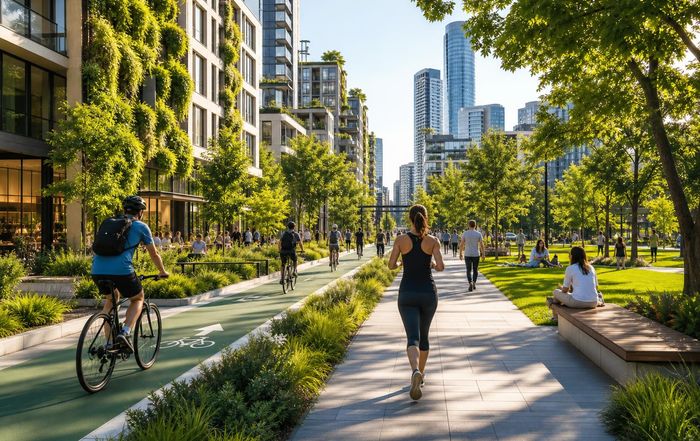
How Urban Design Encourages More Active Lifestyles
In cities around the world, a quiet revolution is reshaping streets, parks and public spaces. Rather than centering everything around cars and congestion, a growing movement in urban design is re-centering daily life around people, health and community. For readers of WorldsDoor, who explore the intersections of travel, culture, health, lifestyle and the environment, this shift is more than a planning trend; it is changing how people move, connect and experience the world's great urban destinations.
Thank you for being part of our growing worldwide readership. We publish original long-form articles daily to keep you informed, engaged, and encouraged.
The Health Imperative Behind Active Cities
Public health research over the past two decades has drawn a clear connection between the design of cities and the health of the people who live in them. Organizations such as the World Health Organization have repeatedly highlighted physical inactivity as a major risk factor for noncommunicable diseases, including cardiovascular disease, diabetes and certain cancers, and have emphasized that urban planning decisions can either encourage or discourage daily movement. Readers can explore the broader context of these findings through the WHO's discussion of physical activity and health.
In parallel, studies published in journals covered by The Lancet and other leading medical publishers have shown that residents of walkable neighborhoods, with access to sidewalks, mixed land uses and public transport, tend to walk more, have lower rates of obesity and benefit from improved mental health compared with those living in car-dependent environments. The U.S. Centers for Disease Control and Prevention has gone so far as to recommend community design interventions-such as connected street networks and accessible parks-as part of its guidance on healthy community design.
For WorldsDoor daily readers interested in the intersection of urban life and personal well-being, this evidence underscores a simple but powerful idea: when movement is built into everyday routines through thoughtful design, people are more likely to stay active without needing to carve out extra time or willpower. This aligns closely with the themes explored in WorldsDoor's own coverage of health and well-being, where lifestyle choices and environmental context are seen as mutually reinforcing.
Walkability: Designing Streets That Invite Movement
Among the most studied concepts in contemporary planning is walkability, which captures how friendly an area is to walking for transport, leisure and social interaction. Key ingredients include continuous and well-maintained sidewalks, safe street crossings, short blocks, mixed land uses that bring homes close to shops and services, and an attractive public realm that feels comfortable and interesting at a walking pace.
Initiatives such as Walk Score, which rates neighborhoods across countries like the United States, Canada, the United Kingdom and Australia, have popularized the idea that walkable areas are not only healthier but also more desirable places to live. Research summarized by the National Institutes of Health suggests that people who live in high-walkability neighborhoods can accumulate significantly more daily physical activity, often just by walking to transit, work, school or local amenities.
Cities from Copenhagen to Melbourne have become global case studies in how to prioritize pedestrians. Copenhagen's long-term strategy, influenced by urbanist Jan Gehl and documented by organizations such as Gehl Architects, has converted traffic-dominated streets into pedestrian-focused public spaces, leading to high levels of walking and cycling. In Melbourne, policies to encourage street-level activity and outdoor dining have similarly transformed previously car-oriented districts into vibrant, walkable neighborhoods.
For travelers who follow WorldsDoor's insights on urban travel and exploration, understanding walkability provides a useful lens for choosing destinations and neighborhoods that foster movement and discovery. Walkable cities not only support health but also offer richer cultural experiences, as visitors are more likely to stumble upon local cafés, galleries and markets that are easily missed when traveling by car.
Cycling Networks and Micromobility as Everyday Transport
Alongside walking, cycling and other forms of micromobility-such as e-bikes, scooters and cargo bikes-have emerged as central pillars of active urban design. The European Cyclists' Federation and national transport agencies in countries like the Netherlands and Denmark have documented how safe, separated cycling infrastructure can dramatically increase the share of trips made by bicycle, thereby integrating exercise into daily commutes and errands. Readers can explore broader cycling policy trends through resources from Cycling UK and the Dutch Cycling Embassy.
In the Netherlands, cities such as Amsterdam and Utrecht have built extensive networks of protected bike lanes, bicycle parking hubs and traffic-calmed streets, resulting in cycling rates that are among the highest in the world. According to data regularly compiled by the Government of the Netherlands, cycling is not primarily a leisure activity but a normal mode of transport for all ages. Similar transformations are underway in North American and Asian cities, with places like Montreal, Vancouver and Seoul expanding protected lanes and experimenting with bike-sharing systems.
The rise of e-bikes, documented by organizations such as the International Energy Agency, has made cycling accessible to a wider population, including older adults and people living in hillier areas. While debates continue about the regulation of shared e-scooters and safety standards, multiple studies cited by the OECD's International Transport Forum suggest that when properly integrated with infrastructure and rules, micromobility can replace a substantial share of short car trips in urban areas, further embedding physical activity into everyday life.
From the perspective of WorldsDoor's readers interested in lifestyle evolution in cities, the growth of cycling culture is not only about transport; it touches fashion, local business, family routines and even tourism, as more visitors choose to explore cities on two wheels to experience neighborhoods at a human scale.
Public Transport and the "Last Mile" of Activity
Active lifestyles in cities are not limited to walking and cycling alone; public transport plays a critical role by encouraging people to walk or cycle to and from stations and stops. Research highlighted by the American Public Transportation Association and health agencies indicates that transit users often accumulate more daily steps than those who drive, as they integrate short walks into their commuting routines.
Cities that design integrated networks of buses, trams, metro lines and commuter rail, complemented by pedestrian-friendly station areas, effectively build activity into the structure of daily life. In places like Tokyo, Paris and Singapore, dense transit networks are supported by mixed-use development around stations, reducing dependence on private cars and making it easy for residents to reach workplaces, schools, shops and cultural venues on foot.
The concept of "transit-oriented development," promoted by organizations such as ITDP - Institute for Transportation and Development Policy, emphasizes compact, walkable neighborhoods anchored by high-quality public transport. This approach has been adopted in a range of countries, from the United States to Brazil and China, and is increasingly seen as a way to address public health, climate change and housing affordability simultaneously.
For WorldsDoor's global audience, which often seeks out cities that blend efficient mobility with rich cultural life, transit-oriented urbanism offers a blueprint for destinations where movement, sustainability and social vibrancy are mutually reinforcing. Readers interested in the broader societal implications of such models can explore related themes on WorldsDoor's pages dedicated to society and community change.
Parks, Greenways and the Nature-Activity Connection
Access to green space is another cornerstone of active urban living. Parks, waterfronts, greenways and urban forests offer residents and visitors alike opportunities for walking, running, cycling and informal play, while also providing mental restoration and contact with nature. The United Nations Environment Programme and the European Environment Agency have both highlighted the importance of urban green infrastructure in reducing heat, improving air quality and encouraging physical activity.
Research summarized by the Harvard T.H. Chan School of Public Health indicates that proximity to green spaces is associated with reduced stress, better cardiovascular health and higher levels of physical activity across age groups. Cities such as Singapore, often described as a "City in Nature," have pursued ambitious greening strategies that integrate parks, sky gardens and linear green corridors into dense urban districts, thereby inviting residents to walk or cycle through shaded, biodiverse environments.
In North America and Europe, the conversion of former industrial corridors and rail lines into greenways-such as New York's High Line or Paris's Coulée Verte-has demonstrated how creative design can reclaim underused infrastructure for public health and recreation. These projects, documented by organizations like Project for Public Spaces, also illustrate how thoughtful programming and design can encourage people of different ages and backgrounds to gather, move and interact.
For WorldsDoor, which regularly explores the relationship between environmental stewardship and human well-being, such examples underscore the potential of urban nature not only to mitigate climate impacts but also to serve as a daily invitation to move, breathe and connect.
The "15-Minute City" and Compact Urban Living
One of the most influential urban concepts to gain prominence in recent years is the "15-minute city," popularized by French-Colombian scientist Carlos Moreno and embraced by cities such as Paris. The idea is straightforward yet transformative: residents should be able to access essential services-work, education, shopping, healthcare and leisure-within a roughly 15-minute walk or bike ride from home. The C40 Cities Climate Leadership Group and other international networks have promoted this model as a way to cut emissions, reduce congestion and enhance quality of life.
In practice, the 15-minute city concept encourages mixed-use zoning, neighborhood-level amenities, decentralized cultural venues and a rebalancing of street space away from through-traffic and toward local life. While some debates have emerged in certain countries, sometimes fueled by misinformation about supposed restrictions on movement, planning documents from cities like Paris, Barcelona and Melbourne make clear that the intention is to expand choice and convenience rather than limit freedom of travel. Independent reporting by outlets such as BBC News and The Guardian has documented both the enthusiasm for and the misunderstandings around this model.
From a health perspective, compact, mixed-use neighborhoods naturally encourage walking and cycling because daily destinations are closer. For the WorldsDoor community, which values the discovery of local culture and everyday life, the 15-minute city offers a vision of urban living where authentic experiences are woven into each short journey, whether that means walking to a neighborhood market, cycling to a small theater or meeting friends in a nearby park. These themes resonate with WorldsDoor's exploration of urban culture and creativity, where the focus often falls on how city form shapes social and artistic expression.
Designing Streets as Social and Cultural Spaces
Beyond their function as transport corridors, streets are increasingly being reimagined as social, cultural and recreational spaces. Concepts such as "complete streets," "slow streets" and "superblocks" seek to balance the needs of pedestrians, cyclists, transit users and drivers, while also creating room for outdoor dining, markets, performances and informal play. The National Association of City Transportation Officials has published widely used design guides illustrating how narrower lanes, wider sidewalks, street trees and traffic calming can make streets safer and more inviting for active use.
Barcelona's "superblocks" initiative, which groups city blocks together and restricts through-traffic within them, has been particularly influential. Evaluations reported by institutions such as ISGlobal suggest that these redesigned areas can lead to increased walking and cycling, reduced air and noise pollution and greater use of public space for social activities. Similar experiments, from Oslo's efforts to reduce cars in its city center to London's low-traffic neighborhoods, have shown that reallocating street space away from private vehicles can quickly change mobility patterns and encourage more active modes.
For the global audience of WorldsDoor, which often seeks destinations where public life spills into the streets, these design transformations are reshaping the experience of travel itself. Visitors can now encounter streets that function as open-air living rooms, where it feels natural to stroll, linger and engage rather than simply pass through. This evolution aligns with WorldsDoor's interest in innovative approaches to urban living, where design is a tool for fostering both movement and meaningful encounters.
Equity, Inclusion and the Right to Move
While the benefits of active urban design are increasingly well documented, questions of equity and inclusion remain central. Historically, low-income neighborhoods and marginalized communities have often been underserved by quality sidewalks, parks, cycling infrastructure and reliable public transport. Organizations such as UN-Habitat and the World Bank have emphasized that inclusive urban planning must ensure that all residents, regardless of income, age, gender or ability, can safely and comfortably choose active modes of transport.
In cities across North America, Europe, Africa and Asia, community-led initiatives have emerged to advocate for safer streets, better lighting, accessible transit stops and culturally relevant public spaces. Research compiled by the Global Designing Cities Initiative shows that small design changes-such as curb ramps, tactile paving, benches, shade structures and traffic calming near schools-can make a significant difference for older adults, children and people with disabilities, enabling them to participate more fully in active city life.
For WorldsDoor, which examines ethical and societal dimensions of development, the push for equitable active design raises important questions about who benefits from urban improvements and how communities can be meaningfully involved in planning decisions. Ensuring that active lifestyles are not a privilege of a few, but a right shared by all, is likely to remain a central challenge and opportunity for cities worldwide in 2026 and beyond.
Technology, Data and Smart Approaches to Active Design
Advances in technology are providing urban planners with new tools to understand how people move through cities and to design environments that support more active lifestyles. Mobile phone data, GPS traces from fitness apps, and sensors embedded in streets and public spaces can reveal patterns of walking and cycling, helping cities identify gaps in networks, dangerous intersections and underused areas that could be transformed. Organizations such as MIT Senseable City Lab and various urban innovation hubs have showcased how anonymized movement data can inform more responsive and adaptive design.
At the same time, digital platforms are empowering residents to participate more directly in shaping their environments. Participatory mapping tools, online surveys and neighborhood planning apps allow citizens to highlight where they feel unsafe walking, where they would like new bike lanes or parks, and how they experience their daily journeys. While privacy and data governance remain important concerns, the potential for technology to bridge the gap between lived experience and professional planning is increasingly recognized by city governments and civic organizations alike.
For readers of WorldsDoor who follow emerging technologies and their social impacts, this intersection of data, design and public health illustrates how innovation can be harnessed to support human-scale goals. The challenge is to ensure that digital tools serve as instruments of inclusion, amplifying diverse voices and leading to tangible improvements in the walkability, safety and livability of neighborhoods.
Active Design in a Changing Climate
Climate change adds another layer of urgency and complexity to the design of active cities. Heatwaves, flooding and air pollution can all discourage outdoor activity, particularly among vulnerable populations, yet many of the strategies for climate resilience overlap with those that promote active lifestyles. Shaded sidewalks, tree-lined streets, permeable surfaces, green roofs and waterfront parks can simultaneously cool cities, manage stormwater and create inviting environments for walking and cycling.
Reports from the Intergovernmental Panel on Climate Change and urban climate initiatives have stressed that reducing car dependence through compact, transit-rich, walkable urban forms is one of the most effective ways to cut greenhouse gas emissions from the transport sector. In this sense, designing for active mobility is not only a public health measure but also a core climate strategy. Cities that reallocate road space to buses, bikes and pedestrians, and that encourage mixed-use development, are taking steps toward both healthier residents and a more stable climate.
WorldsDoor's focus on sustainable futures and responsible travel connects closely with this dual agenda. As travelers increasingly seek to minimize their environmental footprint, cities that support car-free exploration, efficient public transport and walkable neighborhoods become particularly attractive, offering experiences that align with both personal health goals and global climate responsibilities.
What This Means for Travelers, Residents?
For individuals, the evolution of urban design offers practical and inspiring possibilities. Residents can seek out neighborhoods with good sidewalks, nearby parks and access to transit, or advocate locally for safer crossings, bike lanes and traffic calming. Travelers can choose destinations known for walkability and cycling infrastructure, planning itineraries that emphasize exploration on foot or by bike, thereby experiencing places more intimately while staying active.
For city leaders, planners and designers, the message is clear: environments that make walking, cycling and transit the easiest and most pleasant choices can deliver significant benefits for physical and mental health, social cohesion, cultural vitality and environmental sustainability. Organizations such as UNESCO have increasingly recognized the role of urban public spaces and cultural landscapes in shaping not only heritage and identity but also everyday well-being.
For WorldsDoor itself, this global movement toward active urban design resonates deeply with the platform's mission to open doors-literal and metaphorical-between people and places. As WorldsDoor continues to explore world trends and global perspectives, stories of cities that successfully align design, health, culture and sustainability will remain central to its coverage. Whether examining a new pedestrian boulevard in a European capital, a community-led cycling initiative in an African metropolis or a greenway project in a North American or Asian city, the lens of active design provides a unifying narrative: that how humanity shapes its cities will profoundly influence how people move, connect and thrive.
As more cities around the world reimagine their streets and public spaces, the connection between urban design and active lifestyles is no longer an abstract theory; it is a lived reality for millions. The path ahead is not without challenges, from funding and political will to equity and climate resilience, but the direction is increasingly clear. By embracing design that invites movement and human interaction, cities can become not only more efficient and sustainable, but also more joyful places to live and explore-an evolution that WorldsDoor will continue to follow, document and share with its global community of curious, health-minded travelers and urban enthusiasts.