

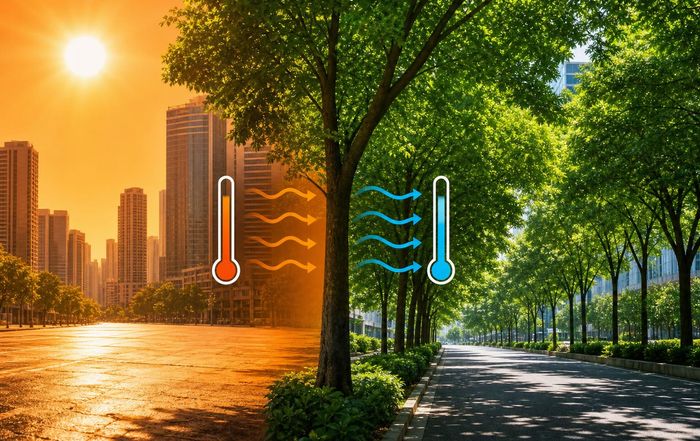
How Urban Tree Canopies Cool Cities and Reduce Extreme Heat
In many of the world's fastest-growing cities, summer now feels less like a season and more like a stress test. Heatwaves are longer, nights stay hot, and concrete-heavy districts turn into radiating plates well after sunset. As planners search for ways to keep cities livable, one solution keeps resurfacing in both climate science and public health research: expanding urban tree canopies. Far from being a cosmetic "green touch," trees function as a critical layer of cooling infrastructure, with measurable impacts on temperature, health, and energy use.
Come into our hidden world of nature and see how and why tree canopies cool cities, what the evidence shows about their effectiveness against extreme heat, and how different regions are trying to plant and protect trees in ways that are fair, resilient, and adapted to a warming climate.
Why cities overheat: the urban heat island problem
Most large cities are several degrees hotter than nearby rural areas, a phenomenon known as the urban heat island. The basic mechanics are well established by organizations such as the U.S. Environmental Protection Agency and NASA. Dense concentrations of asphalt, concrete, and dark roofs absorb large amounts of solar radiation during the day and release it slowly at night. At the same time, buildings block wind, traffic generates waste heat, and air conditioners pump heat from indoors to outdoors, compounding the problem.
Crucially, many urban surfaces are impervious: water cannot soak into the ground, so it runs off into drains instead of evaporating. In natural landscapes, evaporation and plant transpiration transform a large share of solar energy into latent heat, which does not raise air temperature. In a paved city, more of that energy becomes sensible heat, which does. As a result, nighttime temperatures in some large cities can remain 5-7°C (9-13°F) warmer than surrounding rural areas, with higher peaks in certain neighborhoods.
This extra heat is not just uncomfortable. The World Health Organization notes that heatwaves already cause tens of thousands of premature deaths globally each year, with older adults, outdoor workers, and lower-income residents at particular risk. During extreme events, such as the 2003 European heatwave or the 2021 Pacific Northwest heat dome, mortality spikes were closely associated with where people lived in the urban fabric and how much cooling infrastructure-including trees-surrounded them.
How trees cool cities: shade, evapotranspiration, and surfaces
Urban trees reduce heat through a combination of physical processes that together can significantly alter microclimates at street level. While the exact cooling effect depends on climate, species, and urban design, the mechanisms are broadly similar from Berlin to Bangkok.
First, tree canopies provide shade, which reduces the amount of solar radiation reaching pavements, building walls, cars, and people. Shaded surfaces can be 11-25°C (20-45°F) cooler than those in full sun, according to guidance from the U.S. EPA. Because heat from hot pavements and walls is re-radiated into the air, blocking sunlight at the surface level helps prevent air temperatures from rising as quickly. Shade also reduces direct heat stress on the human body by limiting radiant heat load and UV exposure, which is especially important for pedestrians, cyclists, and outdoor workers.
Second, trees cool the air through evapotranspiration. As trees draw water from the soil and release it through their leaves, that water evaporates, absorbing heat from the surrounding air. This process converts sensible heat into latent heat, effectively "using up" some of the sun's energy that would otherwise warm the air. Research synthesized by the Food and Agriculture Organization suggests that well-vegetated urban areas can experience air temperature reductions of 1-5°C compared with nearby built-up zones with minimal vegetation, largely due to evapotranspiration.
Third, tree canopies influence the thermal properties of surfaces beneath them. Shaded asphalt and concrete not only stay cooler during the day but also store less heat to be released at night. Over time, this can reduce the intensity of nighttime heat islands, which are particularly dangerous for human health because they prevent the body from recovering from daytime heat stress. In addition, tree roots, leaf litter, and associated vegetation can increase soil moisture and permeability, further supporting evaporation and moderating temperature swings.
Finally, trees can subtly affect air movement. While dense vegetation can sometimes obstruct breezes, well-designed tree corridors along streets or waterfronts can help channel cooler air into built-up areas and create more comfortable microclimates. Urban climatologists at institutions such as the Royal Meteorological Society have highlighted the importance of combining tree planting with attention to local wind patterns rather than treating greenery as purely decorative.
How much cooling can tree canopies actually provide?
The scale of cooling from urban trees varies widely, but a growing body of research gives a sense of what can be achieved. Satellite and ground-based studies across North America, Europe, and parts of Asia show consistent patterns: neighborhoods with higher tree canopy cover tend to be significantly cooler than those with sparse trees, even when they are only a few blocks apart.
Analyses supported by organizations like The Nature Conservancy and American Forests have found that, on hot summer afternoons, areas with robust tree cover can be 2-4°C (3.6-7.2°F) cooler than nearby low-canopy areas, with some studies documenting differences of 7°C (12.6°F) or more at the hottest times of day. These are local, street-scale measurements, which tend to matter more for actual human exposure than citywide averages.
Some of the most striking evidence comes from "cool corridor" projects where trees are planted strategically along major pedestrian routes or transit stops. Evaluations of such corridors in cities like Melbourne and Singapore, reported by groups including C40 Cities and the World Resources Institute, show reductions in mean radiant temperature-a key indicator of perceived heat-by more than 10°C in shaded zones compared with unshaded reference areas. People walking or cycling along these shaded routes report substantially greater comfort and are more likely to use active transport even on hot days.
However, canopy coverage matters as much as individual trees. A single young tree on a wide, sun-baked boulevard will have limited impact. As tree crowns grow and overlap, the cumulative shade and evapotranspiration begin to create a continuous "cooling layer." Many urban forestry experts now recommend aiming for at least 30% canopy cover at neighborhood scale, a target adopted or discussed in cities such as Sydney, Vancouver, and Barcelona, though the appropriate figure can vary by climate, density, and water availability.
Health, equity, and who benefits from urban trees
The cooling benefits of tree canopies are not distributed evenly. Across many cities in the United States, Europe, Latin America, and beyond, wealthier neighborhoods tend to have more trees, parks, and private gardens, while lower-income districts often have sparse canopy and more heat-absorbing infrastructure. Studies by the U.S. Forest Service and public health researchers have linked these patterns to historic zoning, industrial siting, and even discriminatory practices such as redlining in some American cities.
These environmental inequities translate directly into health risks. During heatwaves, residents of low-canopy neighborhoods face higher exposure to dangerous temperatures, often while also dealing with housing that lacks adequate insulation or air conditioning. People with chronic conditions, outdoor jobs, or limited mobility are particularly vulnerable. Public health authorities, including the Centers for Disease Control and Prevention, emphasize that increasing green cover in underserved areas can be a powerful tool for reducing heat-related illness and mortality, especially when combined with outreach and access to cooling centers.
Urban tree planting can also intersect with issues of social cohesion, safety, and cultural identity. Well-maintained trees and small green spaces can encourage walking, provide informal gathering spots, and support mental health by offering respite from noise and visual stress. For migrants and diaspora communities, certain tree species or planting styles may carry cultural significance, creating a sense of familiarity in new urban environments. However, if not planned carefully, "green upgrades" can also contribute to rising property values and displacement pressure, a dynamic sometimes referred to as green gentrification.
To address these tensions, some cities now embed tree canopy targets into broader urban climate adaptation and social equity plans, often informed by local community groups. This kind of integrated approach connects cooling, public health, society, and environmental justice rather than treating trees as isolated beautification projects.
Trees versus other heat solutions: how they fit into a cooling strategy
Trees are not the only way to cool cities, and they cannot fully offset the warming effects of climate change on their own. But they offer a set of advantages that make them a cornerstone of many urban heat strategies, especially when combined with other measures.
Engineered solutions such as reflective "cool roofs," permeable pavements, and district cooling systems can reduce heat absorption and improve energy efficiency. Building codes, shading devices, and urban design that maximizes natural ventilation also play important roles. Organizations like UN-Habitat and ICLEI - Local Governments for Sustainability encourage cities to adopt portfolios of interventions tailored to local conditions.
Within these portfolios, trees provide a unique combination of cooling and co-benefits. In addition to lowering temperatures, they can improve air quality by filtering fine particles, support urban biodiversity, manage stormwater by intercepting rainfall, and enhance mental well-being. From a climate perspective, trees can sequester carbon, although in dense cities this effect is often modest compared with national-scale forests. Still, when considered alongside their health and social value, urban trees are frequently among the most cost-effective climate adaptation investments.
That said, trees are not always the best option for every location. In very narrow streets with limited sunlight, they may struggle to grow or may impede needed airflow. In arid or water-stressed regions, large canopy trees may require irrigation that competes with other priorities, unless drought-tolerant native species are used. In some contexts, green roofs, shade structures, or reflective surfaces may be more appropriate, at least in the short term. The challenge for planners is not to choose trees instead of other solutions, but to understand where and how tree canopies can deliver the most benefit as part of a wider urban innovation and sustainability strategy.
Designing effective and resilient urban tree canopies
Not all urban forests are equally effective at cooling, and not all are equally resilient to the very climate stresses they are meant to mitigate. Designing tree canopies that can thrive in hotter, drier, and more unpredictable conditions requires attention to species choice, planting design, maintenance, and long-term governance.
Species selection is especially important. Native or climate-adapted species are generally better suited to local pests, diseases, and seasonal cycles, and they often support more local biodiversity. In hotter climates, broadleaf, dense-canopy trees typically provide better shade than narrow-crown species, while in colder climates, a mix of deciduous and evergreen trees can balance summer cooling with winter solar gain. Botanical gardens, forestry agencies, and research institutions, such as Kew Gardens in the UK or the United States Forest Service, increasingly publish guidance on species likely to tolerate future climate conditions.
Diversity within the urban forest is another key consideration. Overreliance on a small number of tree species can leave cities vulnerable to pests or diseases, as seen historically with Dutch elm disease in Europe and North America or more recently with emerald ash borer outbreaks. Many urban foresters now recommend that no single species account for more than 10-15% of the total tree population, with a broader mix at the genus and family level. This diversity supports resilience and can also create a more varied and engaging urban landscape.
Planting design should consider how trees interact with buildings, streets, and underground infrastructure. Root space, soil quality, and access to water are critical for long-term tree health. In compact European districts or dense Asian megacities, innovative approaches such as structural soils, suspended pavements, and shared tree pits are being used to give roots more room beneath sidewalks and plazas. Green corridors that connect parks, riverbanks, and residential streets can help create continuous cooling networks rather than isolated pockets of shade.
Maintenance and governance are often overlooked but decisive. Young trees require watering, pruning, and protection from damage in their first years; without this care, mortality rates can be high, undermining canopy goals. Some cities are experimenting with community stewardship programs, citizen science apps, and public-private partnerships to share the responsibility and benefits of urban forests. For residents, this can also be a way to engage directly with local environment and lifestyle choices, from planting a street tree to supporting neighborhood greening campaigns.
Measuring impact: data, mapping, and planning tools
To make informed decisions about where to plant trees and how to manage them, cities increasingly rely on data and mapping tools. High-resolution satellite imagery, aerial LiDAR, and street-level surveys are used to map existing canopy cover, identify gaps, and correlate tree presence with temperature, health outcomes, and socio-economic indicators.
Organizations like NASA, ESA, and national meteorological agencies provide open climate and land-surface data that can be integrated into urban planning. Non-profit groups such as The Nature Conservancy, World Resources Institute, and C40 Cities have developed tools and case studies that help cities quantify the cooling benefits of trees, estimate avoided heat-related mortality, and prioritize investments in neighborhoods with the highest vulnerability.
Some municipalities have turned these analyses into explicit policy targets: for example, setting minimum canopy percentages for each district, embedding tree protection in zoning rules, or tying planting programs to heat-health action plans. Others integrate tree canopy expansion into bigger sustainable urban development strategies that also address transport, energy, and housing.
For residents, publicly accessible tree inventories and canopy maps can increase transparency and engagement. People can see where trees are lacking, request new plantings, or participate in monitoring. In a few cities, these tools are linked with heat-risk maps used by health departments and emergency services, helping to coordinate responses during extreme heat events.
Practical implications for travelers, residents, and planners
For people moving through cities-whether as daily commuters or international travelers-tree canopies shape how the urban environment feels and how safely it can be navigated during heatwaves. Well-shaded streets and parks make walking and cycling more viable in hot climates, reducing reliance on air-conditioned vehicles and supporting more active travel and lifestyle choices. For visitors exploring destinations from Singapore to Seville, the presence of tree-lined avenues or green public squares can make the difference between a pleasant afternoon and a cut-short outing due to heat stress.
Residents can advocate for more trees on their streets, support local planting initiatives, and take part in stewardship programs that help young trees survive and thrive. Small actions-such as watering a newly planted street tree during dry spells or reporting damaged trees-can collectively influence how quickly canopy cover grows. At the same time, it is important to recognize that individual efforts work best when backed by coherent citywide policies and investment.
For urban planners, architects, and policymakers, integrating trees into the core of urban design and world-scale climate strategy is increasingly seen as a necessity rather than an optional amenity. This involves balancing competing land-use pressures, ensuring that tree benefits reach those most exposed to heat, and planning for long-term maintenance under changing climate conditions. It also means recognizing that trees are part of a broader urban ecosystem that includes water management, building materials, and social spaces.
Keeping cities livable in a hotter world
As global temperatures rise and extreme heat events become more frequent, urban tree canopies stand out as one of the few interventions that can simultaneously cool cities, improve health, support biodiversity, and enhance everyday quality of life. They are not a silver bullet, and they cannot substitute for reducing greenhouse gas emissions. But in the decades ahead, the presence or absence of trees may help determine which neighborhoods remain livable during summer heatwaves and which face escalating risks.
For city leaders, the question is no longer whether trees reduce urban heat-they do-but how quickly and fairly canopy can be expanded, and how well it can be sustained. For residents and travelers, paying attention to the shade overhead is a way to read a city's priorities: where trees thrive, people usually can too.
For further important reading on climate, health, and sustainable urban living, related reporting is available in our super sections on health, environment, sustainable cities, technology and innovation, and global society.