

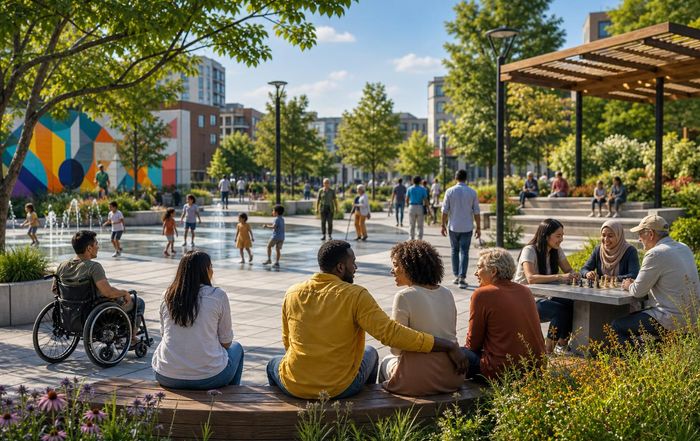
How Public Spaces Build More Inclusive Communities
Public spaces have become one of the most powerful quiet forces shaping modern life. From neighborhood parks and waterfront promenades to libraries, transit hubs, and digital commons, the way these shared environments are designed and governed increasingly determines who feels they belong, who meets whom, and how communities weather social and environmental change. For WorldsDoor, whose frequent flying jet setting readers look outward to understand how people live, travel, work, and connect across cultures, the story of inclusive public space is also a story about how the world's doors-physical and metaphorical-are opened or closed to different groups of people.
Rethinking Public Space in a Changing World
Across continents, planners, architects, and community organizers are reimagining public spaces as engines of inclusion rather than mere backdrops to daily life. Research from organizations such as UN-Habitat shows that well-designed public spaces can reduce social isolation, support public health, and strengthen democratic participation. Readers can explore broader global urban trends through resources like UN-Habitat's work on public space and the World Health Organization's guidance on healthy cities.
The last decade has seen powerful demonstrations of how streets, squares, and parks can be both contested and transformative. Public squares in cities from Cairo to Hong Kong, New York to Barcelona, have hosted movements for democracy and social justice, while also revealing longstanding inequalities in who feels safe and welcome in these environments. The COVID-19 pandemic, which reshaped public life worldwide, accelerated experiments such as "open streets," outdoor dining, and pop-up bike lanes, many of which have since become permanent features in cities like Paris, Milan, and New York City, as documented by groups such as C40 Cities and the National Association of City Transportation Officials.
In 2026, the conversation has shifted from whether public space matters to how it can be intentionally designed and managed to support inclusion across lines of age, income, ability, gender, race, and culture. At WorldsDoor, this big shift resonates with ongoing explorations of world culture, global lifestyles, and the evolving ways people share cities and landscapes.
Designing for Belonging: Principles of Inclusive Public Space
Inclusive public spaces do not happen by accident. They are the result of deliberate choices about accessibility, safety, representation, and programming. International frameworks, such as the United Nations' Sustainable Development Goal 11 on sustainable cities and communities, highlight universal access to safe, inclusive, and accessible green and public spaces as a key target, particularly for women, children, older persons, and people with disabilities. Readers can learn more about these goals through the UN Sustainable Development Goals platform.
Accessibility is a foundational element. This includes physical access-such as step-free routes, tactile paving, clear signage, and inclusive playgrounds-as well as economic and social access, ensuring that cost, dress codes, or unwritten social norms do not exclude certain groups. Organizations like Inclusive Design for Getting Outdoors (IDGO) in the United Kingdom and global networks of disability advocates have documented how small design choices, from seating with armrests to quiet sensory-friendly areas, can determine whether older adults or neurodivergent visitors feel welcome.
Equally important is safety, both real and perceived. Crime prevention through environmental design (CPTED) has long informed urban planning, but more recent approaches emphasize that over-securitized or heavily policed spaces can alienate marginalized communities. Research from institutions such as the London School of Economics Cities program and the Brookings Institution's Metropolitan Policy Program suggests that active, well-used spaces with a diversity of users, clear sightlines, and community stewardship often feel safer than spaces that rely solely on surveillance or enforcement.
Representation and cultural resonance are also critical. Public art, signage in multiple languages, and programming that reflects local communities' histories and traditions can transform a generic plaza into a place of shared pride. Projects like the High Line in New York or Superkilen Park in Copenhagen have been widely studied by organizations such as Project for Public Spaces and the Gehl Institute for how they weave global and local narratives into their design, though debates continue about gentrification and displacement around such high-profile projects.
For readers of WorldsDoor interested in how these design principles intersect with broader questions of society and social cohesion, inclusive public spaces offer a tangible lens through which to see abstract values made real in everyday life.
Public Spaces as Bridges Between Cultures
Travelers often experience cities first and most vividly through their public spaces: a bustling market in Marrakech, a quiet square in Kyoto, a canal-side bench in Amsterdam, or a waterfront promenade in Cape Town. These spaces can act as cultural classrooms, where residents and visitors encounter one another's customs, languages, and daily rhythms in a relatively informal, low-pressure setting.
Cultural theorists and urban sociologists, including scholars at institutions such as the Massachusetts Institute of Technology (MIT) and University College London, have argued that public spaces are crucial "third places" beyond home and work where social mixing can occur. While some critiques point out that not all groups experience these places as equally welcoming, there is growing evidence that inclusive programming-festivals, performances, language exchanges, and community markets-can foster intercultural understanding. Readers who wish to delve deeper into this research can consult resources from the MIT Department of Urban Studies and Planning and the Royal Town Planning Institute.
Cities across Europe, North America, Asia, and Africa have experimented with using public spaces to celebrate cultural diversity. In Toronto, for example, neighborhood parks regularly host multicultural festivals and community-led events, supported by municipal initiatives documented by the City of Toronto and local nonprofits. In Melbourne, laneways have become canvases for street art that reflect both local and global influences, with cultural organizations and city agencies working together to manage these spaces as living galleries rather than static monuments.
For travelers reading WorldsDoor, these examples underscore how public spaces can shape the experience of a destination far beyond its iconic landmarks. A well-loved neighborhood park or lively public square often reveals more about a city's values, tensions, and aspirations than any single museum or monument. Exploring such spaces becomes a way not only to see a place but to feel, however briefly, part of its everyday life, complementing more traditional forms of travel discovery.
Health, Well-Being, and the Everyday Power of Shared Spaces
Public spaces are also increasingly recognized as vital infrastructure for public health. The World Health Organization and national health agencies in countries like Canada, Australia, and Sweden have documented the links between access to green spaces and improved physical and mental health outcomes, including reduced stress, increased physical activity, and better cardiovascular health. Readers can explore these connections through resources such as the WHO Urban Green Spaces and Health report.
During the COVID-19 pandemic, parks, trails, and waterfronts became essential refuges for millions of people worldwide, highlighting inequities in access to quality outdoor spaces. Studies led by universities such as Harvard, University of British Columbia, and University of Sydney reinforced that neighborhoods with more accessible green areas experienced better mental health resilience, especially among children and older adults. These findings have spurred renewed investment in urban greening initiatives, from pocket parks in dense cities like Hong Kong and Singapore to large-scale urban forest projects in Germany and China.
Inclusive public spaces also play a role in addressing loneliness and social isolation, which organizations such as the U.S. Surgeon General's office and the UK's National Health Service (NHS) have identified as pressing public health challenges. Benches that invite lingering, community gardens that encourage shared stewardship, and plazas designed for informal gatherings can create small but meaningful opportunities for connection. Readers interested in the health dimensions of community design can find further insights through WorldsDoor's coverage of health and well-being and external resources like the Centers for Disease Control and Prevention's Healthy Places initiative.
For WorldsDoor, which often highlights the intersection of health, lifestyle, and environment, the emerging consensus is clear: inclusive public spaces are not aesthetic luxuries but essential components of a healthy, resilient society.
Environmental Resilience and the Green Public Realm
As climate change continues to shape the twenty-first century, public spaces are increasingly tasked with doing double or triple duty: providing recreation and social interaction while also managing stormwater, mitigating heat, and supporting biodiversity. Urban parks, greenways, and waterfronts have become frontline infrastructure in cities from Rotterdam to Bangkok, where rising seas and extreme weather events demand creative adaptation strategies.
Organizations such as the World Resources Institute (WRI) and the International Union for Conservation of Nature (IUCN) have documented how nature-based solutions in public spaces, such as restored wetlands, urban forests, and green roofs accessible to the public, can reduce flood risk and urban heat island effects while offering residents attractive places to gather. Examples include the Cheonggyecheon Stream restoration in Seoul and the Madrid Río project in Spain, where former highways have been transformed into linear parks that combine ecological restoration with social amenities. Readers can learn more about these approaches by exploring the WRI's work on urban resilience and the IUCN's nature-based solutions resources.
In 2026, many cities in Europe, North America, and Asia are integrating climate resilience directly into their public space strategies. The European Environment Agency has highlighted how green and blue infrastructure-parks, rivers, canals, and coastal zones-can serve as shared spaces that also protect cities from climate impacts. At the same time, environmental justice advocates in the United States, South Africa, Brazil, and elsewhere emphasize that these investments must be distributed equitably, ensuring that low-income and historically marginalized communities benefit from climate-adaptive public spaces rather than being displaced by rising property values.
For readers engaged with environmental issues and sustainability, this convergence of ecological and social goals offers a hopeful narrative: public spaces can be designed to cool cities, support wildlife, and bring people together, demonstrating that environmental resilience and social inclusion are not competing objectives but mutually reinforcing ones.
Technology, Innovation, and the Digital Public Realm
Technology is reshaping public spaces in subtle and dramatic ways, from free public Wi-Fi and interactive art installations to smart lighting, digital wayfinding, and augmented reality experiences. Cities such as Barcelona, Singapore, and Amsterdam have become testbeds for "smart city" initiatives that integrate sensors, data platforms, and responsive infrastructure into parks, plazas, and transit hubs. Organizations like the Smart Cities Council and research centers at universities including ETH Zurich and Carnegie Mellon University analyze how these technologies can enhance safety, accessibility, and user experience.
However, the rise of digital infrastructure in public spaces also raises concerns about privacy, surveillance, and equitable access. Civil society organizations and digital rights advocates, including the Electronic Frontier Foundation (EFF) and the Open Data Institute, have urged cities to adopt transparent governance frameworks for data collected in public areas, ensuring that residents understand how information is used and have a voice in decision-making. These debates became particularly visible in controversies around proposed "smart neighborhoods," such as the now-cancelled Sidewalk Labs project in Toronto, which prompted extensive public discussion about corporate control of urban data.
At the same time, digital tools are expanding the very definition of public space. Online platforms, virtual events, and social media-based communities have become important venues for civic engagement and cultural exchange, especially for people who may feel excluded from physical public spaces due to mobility limitations, discrimination, or geographic isolation. Hybrid models, where digital platforms support physical gatherings-such as community-organized cleanups, mutual aid networks, or cultural festivals-are becoming more common.
Readers here interested in how technology and innovation intersect with everyday life can see in these developments both promise and complexity. When thoughtfully governed, digital tools can make public spaces more responsive and accessible; when deployed without community input, they risk deepening existing inequalities. The challenge for cities and communities worldwide is to harness technological innovation in ways that strengthen, rather than undermine, the inclusive character of shared spaces.
Food, Markets, and the Social Life of Streets
Food has always been a powerful connector, and public spaces centered around food-markets, street food corridors, community kitchens, and open-air cafés-are among the most inclusive environments many cities offer. From the mercados of Spain and Mexico to the hawker centers of Singapore and night markets in Thailand and Taiwan, such spaces bring together people of different backgrounds through the simple, universal act of eating.
Urbanists and cultural historians, including those at UNESCO and the Food and Agriculture Organization (FAO), have highlighted how traditional markets support local economies, preserve culinary heritage, and foster social ties. Some markets, such as Borough Market in London or Pike Place Market in Seattle, have become global destinations, while still serving as everyday gathering places for residents. Learn more about how food systems and public space intersect through resources from the FAO on urban food systems and UNESCO's work on intangible cultural heritage.
In many cities, community gardens and urban farms are transforming underused lots and public land into shared spaces for growing food, building skills, and strengthening social networks. Programs in Berlin, Detroit, Johannesburg, and Sydney demonstrate how such initiatives can support food security while also creating intergenerational and intercultural connections. For readers of WorldsDoor exploring global food cultures and lifestyle trends, these spaces illustrate how everyday practices like gardening and cooking can become powerful tools for inclusion and empowerment.
Street design also plays a crucial role. When sidewalks are wide, crossings are safe, and traffic is calmed, café terraces, food stalls, and informal seating can flourish, creating vibrant social life at eye level. Organizations such as NACTO and the Global Designing Cities Initiative provide design guidance that many municipalities now use to prioritize people over cars, making streets more welcoming for pedestrians, cyclists, and small businesses. These changes are not only aesthetic; they reshape who feels comfortable spending time in public and how likely people are to encounter neighbors and strangers alike.
Education, Civic Life, and Everyday Democracy
Public spaces have long served as stages for civic life, from town squares and university campuses to libraries and community centers. In many democracies, the right to assemble peacefully in public is a cornerstone of political expression, and recent years have seen renewed attention to how public spaces support or hinder this right. Studies from organizations such as Human Rights Watch and the International Center for Not-for-Profit Law track global trends in freedom of assembly, noting both positive reforms and new restrictions in different regions.
At a more everyday level, public spaces can function as informal classrooms and laboratories of citizenship. Children learn to negotiate differences on playgrounds; teenagers experiment with identity and independence in plazas and malls; older adults share stories and skills in community gardens and local parks. Libraries, which increasingly serve as multi-purpose civic hubs, offer free access to information, digital resources, and community programs, often acting as some of the most inclusive indoor public spaces in a city. The International Federation of Library Associations and Institutions (IFLA) documents how libraries worldwide are adapting their roles to support social inclusion, digital literacy, and lifelong learning.
Universities and schools also shape public space, not only on campuses but in the neighborhoods around them. Partnerships between educational institutions and municipalities, such as "university-city" collaborations in Boston, Berlin, and Singapore, have led to shared public spaces that host lectures, cultural events, and open days for the broader community. For readers interested in education and learning, these examples highlight how knowledge institutions can extend their reach beyond classroom walls, contributing to more inclusive urban and regional cultures.
In this context, public spaces can be seen as everyday arenas of democracy, where people practice coexistence, negotiate shared norms, and encounter difference in ways that are often more subtle but no less significant than formal political processes.
Building Inclusive Public Spaces: Lessons for Communities and Travelers
The global landscape of public space is complex and evolving, shaped by demographic shifts, technological innovation, climate change, and struggles for social justice. Yet across this diversity, several lessons emerge for communities, policymakers, and travelers alike.
First, inclusive public spaces require sustained community engagement, not only during initial design but throughout their life. Participatory processes-such as co-design workshops, neighborhood councils, and youth advisory boards-help ensure that spaces reflect local needs and can adapt over time. Organizations like Project for Public Spaces and the Participatory City Foundation provide frameworks and case studies illustrating how co-creation leads to more resilient and beloved places.
Second, inclusion must be understood broadly, encompassing accessibility for people with disabilities, safety and dignity for women and LGBTQ+ communities, cultural recognition for minority groups, and economic accessibility for low-income residents. This holistic approach aligns with evolving global conversations about equity and justice, which readers can explore further through WorldsDoor's coverage of ethics and social responsibility and resources from the World Economic Forum on inclusive cities.
Third, public spaces thrive when they are connected-to one another, to nature, to transit, and to digital networks-forming a coherent public realm rather than isolated pockets. Integrated networks of parks, plazas, streets, and community facilities support more sustainable mobility, healthier lifestyles, and richer social interaction. This systems perspective is increasingly central to urban planning practice, as reflected in the work of organizations like the OECD and the World Bank, which emphasize inclusive, connected public spaces as part of broader strategies for equitable development.
For WorldsDoor, whose daily happy mission is to open portals into how people live and connect around the globe, inclusive public spaces offer a powerful narrative thread linking travel, culture, lifestyle, and the shared challenges of building fairer, more sustainable societies. Whether readers are exploring a new city, advocating for better parks in their neighborhood, or simply paying closer attention to the plazas, streets, and green spaces they pass each day, they participate in shaping the public realm.
Ultimately, public spaces are mirrors of collective values and laboratories for the futures communities hope to build. When they are open, welcoming, and thoughtfully designed, they invite people to step through the world's doors together, discovering not only the diversity of others but also new possibilities for shared belonging.