

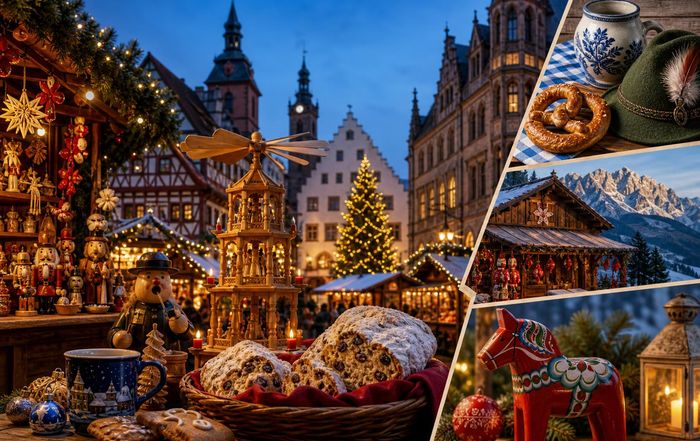
How German Christmas Markets Reflect Regional Traditions
Walk into a German Christmas market in Munich, Dresden, or Cologne and the atmosphere may feel instantly familiar: the smell of roasted nuts, the glow of wooden stalls, the murmur of choirs, the steam from mulled wine. Yet look a little closer and each market reveals a distinct local story. From the pastries in your hand to the ornaments on display and the dialects in the air, these winter gatherings are not a single national tradition but a mosaic of regional identities shaped by history, religion, trade, and landscape.
For travelers planning seasonal trips, understanding these differences can turn a festive stroll into a deeper cultural experience. For locals, they're an annual reminder that Germany is not one culture, but many, coexisting under twinkling lights.
Take a seat and enjoy as we explore how German Christmas markets reflect regional traditions, drawing out the contrasts between north and south, Catholic and Protestant areas, historic trading cities and Alpine villages-and how these markets are evolving in an era of mass tourism and sustainability.
From Medieval Trade Fairs to Modern Winter Rituals
The roots of today's markets lie in late medieval and early modern winter fairs, when towns across Central Europe organized year-end gatherings to supply people with food, clothing, and household items before the long winter. One of the earliest documented markets is Dresden's Striezelmarkt, first mentioned in 1434, originally a one-day meat market before Christmas Eve. Nuremberg's Christkindlesmarkt and Frankfurt's winter fair also trace their origins back several centuries, reflecting the commercial importance of these cities in the Holy Roman Empire.
These early markets were practical rather than romantic. People came for meat, grain, tools, and warm clothing, not decorative gifts. Over time, as urban life stabilized and consumer culture grew, the markets became more focused on seasonal treats, handcrafted gifts, and religious symbolism. The Protestant Reformation also played a role: in many regions, the Christkind (Christ Child) or gift-bringing angels associated with Protestant traditions gradually replaced St Nicholas as the figurehead of Christmas, and markets adapted their imagery accordingly.
Today, Germany's Christmas markets are framed by tourism boards and media as a national cultural export, but historically they developed city by city. Each market's character still reflects its local economy, religious history, and craft traditions. Visitors moving between regions can trace Germany's internal diversity in everything from the music programs to the shapes of gingerbread.
For readers interested in the broader cultural context of travel, these markets sit at the intersection of travel, culture, and society, making them a useful lens on how regional identities are maintained in a globalized country.
North vs. South: Landscape, Faith, and Atmosphere
One of the clearest contrasts is between markets in Germany's north and those in the south, especially Bavaria and Baden-Württemberg. Geography, religious history, and cross-border influences all play a part in shaping what visitors encounter.
In the north, markets in cities such as Hamburg, Bremen, and Lübeck are shaped by maritime history and the legacy of the Hanseatic League. Timber-framed houses and brick Gothic churches provide a distinctive backdrop, and stalls often feature seafaring motifs, smoked fish, and baked goods influenced by Scandinavian and Baltic neighbors. The climate-wetter and windier than the Alpine south-means more covered areas and tented Glühwein stands, and the atmosphere can feel a little more urban and cosmopolitan. Hamburg, for instance, offers both a historic market at the Rathaus and modern themed markets along the harbor, reflecting the city's status as a major port and cultural hub.
The south leans into Alpine imagery: wooden chalets, carved nativity scenes, and mountainous backdrops in cities like Munich, Augsburg, and the small towns of Upper Bavaria. Catholic traditions remain strong, so religious processions, live nativity plays, and church choirs are often more prominent. The influence of nearby Austria and Italy appears in food and music; brass bands, Advent concerts, and baroque church façades give southern markets a different feel from the brick and harbor cranes of the north.
Religious history also matters. Regions that were predominantly Protestant, such as parts of Saxony, Thuringia, and northern Germany, often emphasize the Christkind or neutral winter imagery, while Catholic areas may feature saints, processions, and more elaborate nativity scenes. The famous Christkindlesmarkt in Nuremberg, for example, is opened by a costumed Christkind delivering a prologue from the church balcony-an explicitly religious and regional ritual that has become a tourist spectacle.
For travelers planning itineraries across Germany or Europe, understanding these differences can help decide whether to prioritize a maritime Hanseatic city, a baroque southern town, or an eastern city shaped by different political and cultural histories. Those interested in the broader impact of tourism on local communities can find complementary perspectives in the site's coverage of world and lifestyle topics.
Eastern Traditions: From Ore Mountains Crafts to Dresden's Stollen
Eastern Germany, particularly Saxony and Thuringia, offers some of the most distinctive and historically rich Christmas traditions. Centuries of mining, woodcraft, and porcelain production have left a deep imprint on the markets here, and many of the "classic" German Christmas items sold worldwide originate from this region.
The Ore Mountains (Erzgebirge), on the border between Germany and the Czech Republic, were once a major silver-mining region. When mining declined, local communities turned to woodcarving to survive. Out of this economic shift emerged many of the now-iconic Christmas crafts: Schwibbögen (arched candle holders), Räuchermännchen (incense-smoking figurines), pyramids with spinning tiers powered by candle heat, and finely carved nativity sets. Markets in cities like Chemnitz and Annaberg-Buchholz, as well as stalls in larger cities such as Leipzig and Dresden, still sell these crafts, often produced by family-run workshops.
Dresden's Striezelmarkt highlights another regional specialty: Stollen, a dense fruit bread dusted with powdered sugar. The city even has a protected designation for Dresdner Christstollen, with bakers following specific rules on ingredients and production. Each year, a giant Stollen is ceremonially paraded through the city and sliced for visitors, linking the market to local baking guilds and traditions. Travelers curious about food history will find parallels with other protected regional foods documented by organizations such as the European Union, which manages geographical indications through its official portal.
Nearby Thuringia contributes its own specialties: Thüringer Rostbratwurst, a spiced sausage grilled over charcoal, is a staple of markets in Erfurt and Weimar. Local glass and porcelain traditions, including ornaments from Lauscha, helped popularize the modern Christmas tree decorations that spread across Europe in the 19th century. The region's markets often combine these crafts with a more intimate, small-town atmosphere than the huge events in Berlin or Cologne.
Eastern markets also reflect political history. Under the former GDR, religious elements were downplayed and markets were sometimes reframed as secular winter festivals. Since reunification, many older traditions have been revived or re-emphasized, but traces of the socialist period remain in the architecture, public art, and sometimes in the way events are organized by municipalities rather than church bodies. This layered history makes the region particularly interesting for visitors who see Christmas markets as windows into wider social change, a theme that overlaps with coverage of society and education.
Southern and Alpine Markets: Nativity Scenes, Brass Bands, and Mountain Food
In southern Germany and the Alpine foothills, Christmas markets often feel closely tied to landscape and Catholic ritual. Towns such as Munich, Augsburg, Regensburg, and Rothenburg ob der Tauber present an image of half-timbered houses, church towers, and snow-dusted roofs that matches international expectations of "old Europe," but each has its own regional flavor.
Bavaria is known for its Krippen (nativity scenes), which can be elaborate, life-sized displays in public squares or intricate miniature scenes sold in market stalls. Some regions stage Krippenwege, walking routes linking different nativity displays in churches, shops, and homes. The influence of the Alps is visible in carved wooden figures, cowbells, and mountain motifs. Brass bands and choirs perform Advent music, often mixing religious carols with regional folk songs. Markets in smaller Alpine towns, such as Garmisch-Partenkirchen or Berchtesgaden, may feel more community-focused, with local clubs and associations running stalls to fund their activities.
Food here reflects both the colder climate and cross-border influences from Austria and Italy. Hearty dishes like Käsespätzle (cheese noodles), roasted pork, and dumplings sit alongside sweet items such as Kaiserschmarrn (shredded pancake) and Apfelstrudel. The mulled wine may be joined by Jagertee (a spiced rum-based drink) or regional schnapps. For readers interested in how festive eating intersects with health considerations, especially alcohol and sugar intake during holiday travel, broader guidance can be found in the site's health and food sections.
In Baden-Württemberg, markets like those in Stuttgart or Freiburg showcase Black Forest traditions: cuckoo clocks, cherry-brandy-filled chocolates, and carvings made from local wood. The proximity to France and Switzerland influences both culinary offerings and decorative styles, with Alsatian and Swiss traders often present. This cross-border blending makes southwestern markets a good case study in how regional cultures don't stop at political borders, but flow across them.
The Rhineland and West: Carnival Spirit Meets Advent Calm
The Rhineland and western Germany, including cities such as Cologne, Düsseldorf, and Aachen, offer yet another character. These regions are famous for Karneval, a pre-Lenten festival of costumes and parades, and that sense of spectacle spills over into their Christmas markets.
Cologne hosts multiple themed markets spread across the city, from the large cathedral market to smaller "village" markets along the Rhine. Each has its own visual identity, music program, and food emphasis, and visitors often "collect" them in a single evening. The cathedral backdrop adds a strong religious and architectural presence, but the overall tone is social and lively, reflecting the city's reputation for conviviality.
Aachen's market, near the Belgian and Dutch borders, is known for Printen, a local variant of gingerbread that differs from the more famous Lebkuchen of Nuremberg. The recipe reflects centuries of cross-border trade and spice routes, and today's stalls sell versions ranging from hard, spiced biscuits to softer, chocolate-covered varieties. For those curious about how such regional specialties fit into the wider history of European food, institutions such as the German National Tourist Board at germany.travel and cultural organizations like the Goethe-Institut at goethe.de provide additional context.
In the Ruhr area, former industrial cities such as Essen and Dortmund have repurposed their urban landscapes into illuminated winter spaces, sometimes incorporating mining or steelmaking motifs into decorations. Dortmund is known for one of the tallest Christmas trees assembled from stacked firs, symbolizing both industrial scale and festive excess. These western markets often balance traditional crafts with modern entertainment-ice rinks, light shows, and contemporary music-reflecting a region that has had to reinvent itself after the decline of heavy industry.
Iconic Markets and What Makes Each Distinct
While nearly every German town now hosts some form of Christmas market, a handful have become internationally recognized destinations. Each of these markets embodies a particular regional story rather than a generic "German" template.
The Nuremberg Christkindlesmarkt in Bavaria is one of the most famous. It emphasizes historical continuity, with stalls selling traditional Lebkuchen, prune figurines (Zwetschgenmännla), and wooden toys. The market's opening ceremony, led by the Christkind, underscores Nuremberg's role in shaping Protestant Christmas imagery. Local authorities and organizations such as the Nuremberg tourism office work to preserve the market's character, even as visitor numbers grow.
Dresden's Striezelmarkt centers on Stollen and Ore Mountains crafts, highlighting Saxony's baking and woodworking heritage. The market's giant wooden pyramid and candle arch serve as both decoration and regional branding. Nearby workshops and museums in the Erzgebirge, some supported by regional cultural agencies and documented by organizations like UNESCO at unesco.org, reinforce the idea that these crafts are part of an intangible cultural heritage.
In Munich, the main market on Marienplatz is complemented by specialized events such as the Mittelaltermarkt (medieval market) and a Kripperlmarkt focused on nativity scenes. These reflect both the city's role as a cultural capital and Bavaria's Catholic traditions. Meanwhile, Berlin hosts numerous markets across its districts, from historic Gendarmenmarkt (currently relocated during renovation) to design-focused markets in former industrial spaces, mirroring the city's fragmented history and creative economy.
Smaller towns, such as Rothenburg ob der Tauber in Franconia, Quedlinburg in Saxony-Anhalt, or Lübeck in Schleswig-Holstein, offer markets that integrate seamlessly into preserved medieval or Hanseatic townscapes. These places often appeal to travelers seeking a slower pace and more localized feel, and they illustrate how regional identity is not limited to big-name cities.
For those planning trips with sustainability in mind, the concentration of markets within walkable historic centers also intersects with broader questions about urban design, public transport, and low-impact tourism, topics that connect naturally with the site's environment and sustainable coverage.
Food and Drink: A Map of Regional Flavors
Perhaps the most immediate way to experience regional difference is through what's in the mug and on the plate. While Glühwein (mulled red wine) and Bratwurst appear almost everywhere, local variations tell more specific stories.
In Franconia (northern Bavaria), visitors might encounter white mulled wine made from local white grapes, reflecting the region's wine culture. In winegrowing areas along the Moselle and Rhine, stalls may offer hot spiced wine from regional producers rather than generic blends, and some markets promote local vineyard names as part of their identity. Organizations such as the German Wine Institute at deutscheweine.de highlight the importance of these regional wines in cultural events.
In the north, where beer culture is strong and winters are damp, markets may feature hot beer punches or rum-based drinks, echoing maritime trade links with the Caribbean and Scandinavia. Lübeck is famous for its marzipan, and market stalls there showcase elaborate almond confections drawing on the city's Hanseatic past and access to imported almonds and sugar.
Eastern markets highlight Thuringian sausages, potato pancakes, and baked apples, while Saxony adds quark-filled pastries and distinctive cakes. In the south, cheese-based dishes and hearty meat stews respond to colder mountain climates and pastoral economies. Vegetarian and vegan options, once rare, are now increasingly visible across the country, influenced by broader shifts in German food culture and public health debates, which are also reflected in resources from organizations like the German Nutrition Society at dge.de and the World Health Organization at who.int.
Desserts such as Stollen, Lebkuchen, Spekulatius, and Printen may seem interchangeable to casual visitors, but regional bakers insist on differences in spice blends, dough texture, and glazing. Protected geographical indications and local guilds help maintain these distinctions, turning each market visit into an informal tour of European food law, trade history, and regional pride.
Crafts and Design: Local Materials, Local Stories
Beyond food, the items sold at Christmas markets also reveal regional traditions in materials, skills, and aesthetics. Germany has long been a center of specialized craft production, and many of these industries find their most visible stage in December.
In the Erzgebirge, as noted, woodcarving dominates. The choice of softwoods from local forests, the motifs of miners and angels, and the functional design of candle holders and pyramids all reflect a history of mining and rural life. Workshops in towns like Seiffen often remain family-run, with skills passed down through generations. Cultural heritage bodies and tourism authorities, including the German Commission for UNESCO at unesco.de, have documented how these crafts form part of living traditions rather than static museum pieces.
In Thuringia, glassblowing workshops in places like Lauscha produce hand-blown ornaments, some of which are still sold directly at markets. Their designs range from traditional baubles to political caricatures and contemporary pop-culture figures, illustrating how regional crafts adapt to modern tastes while retaining technical continuity.
In Bavaria and Swabia, woodcarving takes a more religious turn, with detailed nativity figures, crucifixes, and saints' statues. The Catholic visual tradition and baroque church art influence the style and subject matter. In the Black Forest, cuckoo clocks and carved household items link forest resources with a long-standing export industry.
Urban markets in Berlin, Hamburg, or Cologne often host designers and makers from broader creative scenes: ceramicists, illustrators, fashion designers, and social enterprises selling upcycled or fair-trade goods. These stalls reflect contemporary concerns about ethical consumption, global supply chains, and sustainable materials, themes that intersect with global debates on business, innovation, and ethics.
The balance between local crafts and imported mass-produced items varies widely between markets. Some, like Nuremberg or certain smaller town markets, impose rules to favor traditional or handmade products. Others, especially in large cities, accept a mix of regional and international goods. For visitors interested in supporting local economies and minimizing environmental impact, seeking out stalls that identify their regional origins or craft methods can be a practical way to align festive shopping with personal values.
Sustainability, Overtourism, and the Future of the Tradition
As Christmas markets have become major tourist attractions, especially for visitors from the UK, North America, and Asia, they have faced growing questions about sustainability, authenticity, and crowding. Large markets in cities such as Cologne, Nuremberg, and Dresden can draw millions of visitors over a few weeks, putting pressure on public spaces, waste systems, and local communities.
In response, many municipalities are experimenting with more sustainable practices: reusable mugs and plates instead of disposable cups, energy-efficient LED lighting, and better public transport connections. Environmental organizations and city governments, some drawing on guidance from bodies like the German Environment Agency at umweltbundesamt.de and the European Environment Agency at eea.europa.eu, promote waste reduction and lower-carbon event planning. Some markets now charge deposits on cups and encourage visitors to return or keep them as souvenirs, reducing litter.
There is also a growing debate about overtourism and the loss of local character. When a historic town's narrow streets are packed with coach tours, residents may feel pushed out of their own traditions. Some cities have responded by spreading markets across multiple locations, introducing timed entry for certain events, or promoting lesser-known neighborhoods and smaller markets to distribute visitor flows.
At the same time, Christmas markets can support regional economies by providing seasonal income for small businesses, craftspeople, and farmers. They also serve as public spaces where people of different backgrounds share food and music, which has social value beyond tourism revenue. Policy discussions in Germany and the European Union increasingly frame such events within broader strategies on sustainable tourism and cultural heritage, topics that align closely with the themes explored in environment, sustainable, and world reporting.
Public health has also entered the conversation. The COVID-19 pandemic forced the cancellation or heavy modification of many markets, leading to debates about outdoor event safety, vaccination, and crowd management. Institutions such as the Robert Koch Institute at rki.de and the World Health Organization at who.int provided guidance that shaped how markets reopened, with wider aisles, hygiene measures, and sometimes ticketing. While most restrictions have since eased, some of the layout changes and health-conscious habits remain visible.
Reading Germany's Regions Through Winter Light
To an untrained eye, German Christmas markets can blur into one: wooden stalls, twinkling lights, mulled wine, carols. Yet each market is a local conversation about history, belief, economy, and identity. The Ore Mountains' candle arches speak of miners who turned to woodcarving; Dresden's Stollen recalls guild regulations and trade routes; Bavaria's nativity scenes echo centuries of Catholic art; Cologne's multi-site markets reveal a city that balances religious heritage with carnival exuberance; Berlin's patchwork of markets reflects a metropolis built from many districts and histories.
For travelers, paying attention to these differences turns a seasonal outing into a form of cultural literacy. Tasting a regional sausage, asking where a wooden figure was carved, or noticing whether the music is sacred or secular can open up stories about migration, religion, and environmental change. For residents, the markets are an annual reaffirmation that local traditions still matter in a globalized, digitized world.
As debates about sustainability, overtourism, and cultural authenticity continue, the future of German Christmas markets will likely involve careful negotiation between economic needs, environmental limits, and the desire to preserve regional character. For now, though, they remain one of the most accessible ways to "open the door" to Germany's many regions-one mug of Glühwein, one candle-lit craft, and one winter song at a time.