

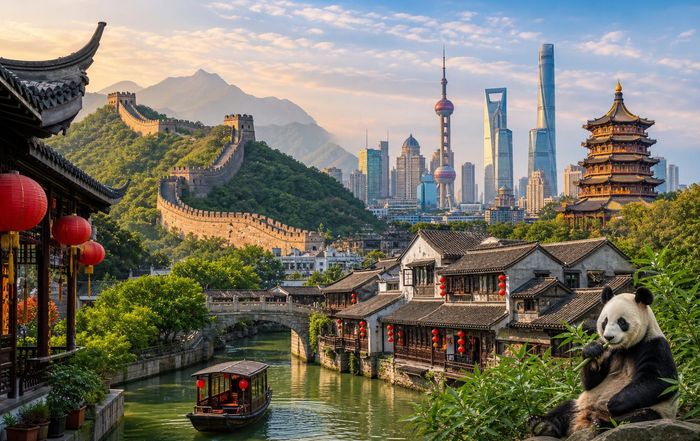
China Travel Tips for Exploring Cities Beyond Beijing
Visitors who only see Beijing often leave China with a narrow sense of the country: imperial palaces, big boulevards, and heavy traffic. Step beyond the capital, however, and an entirely different picture appears-river towns and subtropical mountains, ultra-modern coastal skylines, desert oases, and deeply distinct regional cultures. For travelers interested in understanding China as a diverse, living country rather than a single political symbol, planning an itinerary that focuses on other cities can be far more revealing.
This guide looks at how to explore China beyond Beijing: which regions offer contrasting experiences, how to move between them, what to expect culturally and practically, and how to travel responsibly. It assumes some interest in both travel and culture, and aims to help visitors design trips that go deeper than a standard "Great Wall and Forbidden City" tour.
Choosing where to go: China's regions in broad strokes
China is too large to "cover" in one trip, so the most useful starting point is to choose two or three contrasting regions rather than chase a long list of cities. Official tourism information from China's Ministry of Culture and Tourism at https://www.mct.gov.cn (Chinese and partial English) and broader background from https://www.unwto.org can help with orientation, but it is helpful to think in terms of themes.
Travelers looking for modern skylines, business hubs, and tech culture often gravitate toward Shanghai, Shenzhen, and Guangzhou, where contemporary China is on vivid display through architecture, metro systems, and design. Those interested in older urban fabric and traditional neighborhoods might focus on Xi'an, Pingyao, Suzhou, or Lijiang, where city walls, canals, and historic districts still structure daily life. For dramatic landscapes with strong ethnic minority cultures, Guilin and Yangshuo, Kunming and Dali, or Guiyang and the Guizhou countryside can be compelling choices. Travelers with an interest in environment and sustainability may be drawn to eco-tourism projects in Yunnan or Zhejiang, which connect naturally to broader questions explored in our environment and sustainable travel coverage.
Outside Beijing, a balanced first-time route might combine Shanghai and a nearby water town; Xi'an for history; and a southern or western base like Guilin, Chengdu, or Kunming for landscapes and food. Travelers returning to China may want to push further to cities such as Harbin in the northeast, Xiamen on the southeast coast, or Urumqi in Xinjiang, each of which offers very different social and geographic contexts.
Key urban destinations beyond the capital
Every Chinese city is a universe of its own, but a handful stand out as particularly useful anchors for understanding regional diversity. Official city tourism sites, often linked from https://www.travelchina.org.cn (China National Tourist Office), provide practical details, while broader travel overviews from organizations such as https://www.lonelyplanet.com and https://www.roughguides.com can help refine priorities.
Shanghai and the Yangtze Delta present an immediately different feel from Beijing. The city's colonial-era waterfront, the Bund, faces the hyper-modern skyline of Lujiazui, illustrating how rapidly China's coastal economy has transformed since the 1990s. Neighborhoods such as the French Concession showcase shaded streets, art deco buildings, and a strong café culture, while nearby cities like Suzhou, Hangzhou, and canal towns such as Zhujiajiao or Tongli offer classical gardens, lakeside temples, and more traditional urban forms. For readers interested in how urban design and lifestyle intersect, Shanghai provides a useful contrast to the capital and links naturally with our broader lifestyle and culture reporting.
Xi'an, once the eastern terminus of the Silk Road, is often visited for the Terracotta Army but rewards more time. The intact city walls, Muslim Quarter, and dense street food culture show how historical trade routes still shape contemporary life. Compared with Beijing, Xi'an feels more compact and layered, with Tang dynasty history coexisting with a very current tech and education sector. Background on Silk Road heritage from bodies such as UNESCO at https://www.unesco.org can deepen appreciation of how Xi'an fits into a much larger Eurasian story.
Further south and west, Chengdu in Sichuan province is famous for giant panda research centers and a leisurely tea-house culture, but it is also a major tech hub and gateway to Tibetan areas. The cuisine-bold, spicy, and numbing from Sichuan peppercorns-is a world away from Beijing's northern wheat-based dishes. Food-focused travelers may find Chengdu more aligned with their interests than the capital, and the region's agricultural traditions and peppercorn terroir connect well to broader discussions of food systems explored in our food and world sections.
Guangzhou and Shenzhen, part of the Pearl River Delta, showcase China's manufacturing and innovation engine. Shenzhen transformed from a fishing village to a megacity in just a few decades and now hosts major technology firms such as Huawei and Tencent. Visitors interested in business, supply chains, and the social effects of rapid urbanization can gain more insight here than in Beijing, especially when paired with analysis from international organizations like the World Bank at https://www.worldbank.org or OECD at https://www.oecd.org, which track urban and economic shifts across China.
Beyond the metropolises: smaller cities and regional centers
While China's big-name cities help with orientation, many travelers find that staying in smaller regional centers offers clearer insight into everyday life. Cities like Guilin, Guiyang, Kunming, Xiamen, or Qingdao are large by global standards but feel more accessible, with slower rhythms and closer proximity to rural landscapes.
Guilin and Yangshuo, in Guangxi, are known for their karst mountains and Li River scenery. Guilin functions as a transport hub, while nearby Yangshuo has evolved into a base for cycling, rock climbing, and river activities. Staying in village guesthouses outside Yangshuo or around the Longji Rice Terraces allows visitors to see how tourism interacts with farming communities and minority cultures like the Zhuang and Yao. For those interested in sustainable tourism, comparing on-the-ground realities with principles from bodies such as the Global Sustainable Tourism Council at https://www.gstcouncil.org can be illuminating.
Kunming in Yunnan province is another useful base, sometimes called the "Spring City" for its mild climate. From here, travelers fan out to Dali, Lijiang, and Shangri-La, where Naxi, Bai, and Tibetan cultures are prominent. These areas have seen extensive development and commercialization, raising questions about cultural preservation and authenticity that resonate with broader debates in heritage tourism. Reports and recommendations from ICOMOS at https://www.icomos.org or analyses in international media such as https://www.bbc.com can provide context on how Chinese heritage sites are managed amid mass domestic tourism.
Coastal cities like Xiamen and Qingdao offer yet another variation: maritime histories, European-influenced architecture, and strong beer or tea cultures. Xiamen's Gulangyu Island, for instance, was a foreign concession and today is a pedestrian zone with historic villas and music schools. These cities can feel more relaxed than Beijing or Shanghai and often have strong connections to overseas Chinese communities, adding another layer to the story of migration and identity.
Moving around: trains, flights, and local transport
China's domestic transport network is one of the world's most extensive, and understanding it is key to exploring cities beyond Beijing efficiently. High-speed rail in particular has transformed travel planning. According to data gathered by organizations such as the International Union of Railways at https://uic.org, China operates the largest high-speed rail network globally, linking major cities with frequent, relatively affordable services. Booking tickets usually requires a passport and, for many foreign travelers, either using Chinese-language apps, hotel assistance, or international agents that interface with Chinese platforms. Seats sell out during public holidays and peak weekends, so advance planning is important.
For longer distances-say, from Shanghai to Kunming or Guangzhou to Urumqi-domestic flights remain faster, though high-speed routes are steadily expanding. Safety oversight falls under the Civil Aviation Administration of China, whose English portal is accessible via https://www.caac.gov.cn. Flight delays can be common, especially in congested air corridors, so building flexibility into schedules is wise. Within cities, metro systems in places like Shanghai, Guangzhou, Shenzhen, Chengdu, and Xi'an are extensive, clean, and generally well-signed in English. Smaller cities may rely more on buses and taxis, and ride-hailing apps such as Didi are widely used, though foreign payment integration can be a challenge.
Travelers planning multi-city routes should be aware that some regions require additional permits or have restrictions on independent travel, particularly parts of Tibet and Xinjiang. Official advisories from home-country foreign ministries, such as the U.S. Department of State at https://travel.state.gov or the UK Foreign, Commonwealth & Development Office at https://www.gov.uk, are important reference points, both for security and for changes in entry rules. Balancing ambition with realistic travel times is critical; on maps, cities can appear deceptively close, but even with high-speed rail, distances remain substantial.
Language, communication, and digital life on the road
Outside Beijing and Shanghai, foreign languages are less widely spoken, though younger people in university towns and service industries often have some English. Learning basic Mandarin phrases for transport, food, and directions makes a tangible difference, and even a few characters-such as "出口" (exit) or "门" (door)-can help in stations and metros. Introductory resources from universities such as Peking University at https://www.pku.edu.cn or Tsinghua University at https://www.tsinghua.edu.cn can provide free or low-cost language materials for preparation.
China's digital environment is distinctive. Many Western platforms and news sites are blocked or partially inaccessible, and daily life often revolves around super-apps such as WeChat and Alipay for messaging, maps, and payments. Travelers who rely on services like Google Maps, Gmail, or WhatsApp should consider how they will navigate and communicate. Some visitors use virtual private networks (VPNs) to access familiar tools, although the legal and regulatory environment is complex and subject to change; guidance from digital rights organizations like Access Now at https://www.accessnow.org can help clarify the broader context, but individuals remain responsible for complying with local laws.
Within China, navigation apps from companies like Baidu or Gaode (Amap) are widely used, though English interfaces may be limited. Hotel staff can often help input Chinese addresses into ride-hailing apps or write them down for taxi drivers. For travelers interested in the intersection of technology, society, and travel, experiencing this app-driven ecosystem first-hand can be as revealing as any historic site, and aligns with themes explored in our technology and society coverage.
Regional food cultures: eating your way across China
One of the most compelling reasons to explore cities beyond Beijing is food. China's culinary diversity is immense, and regional capitals often serve as gateways to local ingredients and traditions that rarely appear in overseas Chinese restaurants. Culinary scholarship and documentation from organizations such as Slow Food at https://www.slowfood.com or academic work highlighted by institutions like Harvard University at https://www.harvard.edu can offer deeper context for those curious about food history and regional cuisines.
In the north, cities like Xi'an and Lanzhou are known for hand-pulled noodles, lamb skewers, and breads influenced by Central Asian and Muslim culinary traditions. In Sichuan, Chengdu and Chongqing feature hotpot, mapo tofu, and street snacks built around chili and Sichuan pepper. Coastal cities like Qingdao and Xiamen emphasize seafood, while Guangzhou is central to Cantonese cuisine, including dim sum and delicate soups. Yunnan cities such as Kunming showcase mushrooms, rice noodles, and herbs from mountain ecosystems, connecting food directly to biodiversity and agricultural practices.
Street food scenes vary widely. Chengdu's alleyways, Xi'an's Muslim Quarter, and smaller night markets in cities like Nanning or Guiyang can be immersive but sometimes overwhelming. Following basic food safety principles-choosing busy stalls with high turnover, watching how food is handled, and being cautious with raw or undercooked items-remains important. Health guidance from bodies like the World Health Organization at https://www.who.int or national public health agencies can be useful for general travel health preparation. For readers particularly interested in gastronomy, building itineraries around regional specialties and local markets can provide a powerful lens on culture, economy, and environment, complementing perspectives found in our health and business sections.
Cultural norms, local sensitivities, and everyday etiquette
While big cities like Shanghai or Shenzhen may feel cosmopolitan, local norms still matter and can vary between regions. In many parts of China, especially outside major tourist zones, foreign visitors remain relatively unusual, and curiosity can be direct but generally friendly. Accepting this attention with patience, while also setting clear personal boundaries when needed, helps interactions remain positive.
Basic etiquette includes offering and receiving items with both hands, being respectful around temples and ancestral halls, and avoiding loud or confrontational behavior in public. Photography requires particular care: some religious sites and minority communities are sensitive about being photographed, especially in areas like Tibetan regions of Sichuan or Qinghai. Asking permission-even with gestures-shows respect and can lead to more meaningful exchanges. Cultural organizations and scholars, including those highlighted by UNESCO and academic centers at universities like SOAS University of London at https://www.soas.ac.uk, have documented how tourism can affect minority cultures; being aware of these dynamics can help travelers make more thoughtful choices.
Political topics, including discussions about Tibet, Xinjiang, Hong Kong, or cross-Strait relations, can be sensitive, and local people may be cautious or uninterested in debating them with visitors. Reading a range of perspectives from reputable international outlets such as https://www.reuters.com or https://www.ft.com before traveling can help visitors understand the broader context without putting pressure on casual acquaintances to act as political interpreters. Recognizing that many urban Chinese are focused on work, education, and family rather than geopolitics can also adjust expectations and lead to more grounded conversations.
Practical planning: timing, air quality, and crowded calendars
Choosing when to visit different Chinese cities is as important as deciding where to go. Climate patterns vary widely: winters in Harbin are extremely cold but draw visitors to the ice festival, while summers in Guangzhou or Chongqing can be intensely hot and humid. Spring and autumn are often recommended for many regions, but local factors-monsoon seasons in the south, sandstorms in parts of the north-should be considered. Climate data from national meteorological bodies and global organizations such as the World Meteorological Organization at https://public.wmo.int can help with detailed planning.
Air quality is another consideration, particularly in industrial and northern cities during winter heating seasons. While conditions have improved in many areas compared with a decade ago, pollution peaks still occur. Monitoring tools from platforms like IQAir at https://www.iqair.com or official Chinese environmental agencies can provide real-time data for travelers who are sensitive to air quality. Masks rated for particulate filtration and flexible indoor plans on high-pollution days are sensible precautions.
China's domestic tourism calendar is intense. Major public holidays-especially Spring Festival (Chinese New Year), Golden Week around 1 October, and the early May holiday-see dramatic spikes in travel, with trains and sites packed and prices higher. Visiting popular destinations such as Zhangjiajie, Huangshan, or Lijiang during these periods can mean long queues and limited accommodation. Off-peak travel, including shoulder seasons and weekdays, offers a more relaxed experience and more opportunities to interact with locals outside the pressures of holiday crowds. For travelers interested in how tourism flows affect local economies and environments, comparing holiday versus off-season conditions can be revealing and ties into broader explorations of sustainable tourism in our innovation and ethics sections.
Traveling responsibly: environment, communities, and privacy
Venturing beyond Beijing often means entering regions where tourism is reshaping livelihoods and landscapes in real time. In mountain towns, river valleys, and minority villages, guesthouses and scenic infrastructure can bring income but also strain local water supplies, generate waste, and influence cultural practices. Principles promoted by organizations such as the United Nations Environment Programme at https://www.unep.org or frameworks developed by the Global Sustainable Tourism Council provide useful reference points for travelers who want their trips to have a lighter footprint.
Practical steps include choosing locally owned accommodation and eateries where possible, using refillable bottles in cities with safe filtered water options, and being cautious about wildlife or "animal experience" attractions. For example, in panda centers near Chengdu, visitors can support conservation-focused programs rather than photo-op experiences that might not align with best welfare practices; guidance from reputable conservation organizations like WWF at https://www.worldwildlife.org can help frame these choices. In fragile environments such as karst landscapes, rice terraces, or high-altitude grasslands, staying on marked paths and respecting local rules protects both ecosystems and livelihoods.
Privacy and data considerations also matter. Many Chinese cities are heavily surveilled, with widespread use of cameras and digital monitoring. While this is primarily aimed at public order and domestic governance, travelers who are concerned about digital privacy may wish to limit the personal information they share on local platforms, use strong device security, and be aware that norms around data protection differ from those in some other regions. Human rights organizations and digital rights groups, including Access Now, regularly analyze these issues; following such analyses can help visitors understand the broader context without assuming that every daily interaction is politically charged.
Seeing China as more than its capital
Exploring Chinese cities beyond Beijing is not just about collecting more place names. It is about encountering different ways of organizing urban life, different relationships between city and countryside, and different balances between tradition and rapid change. Shanghai's cosmopolitanism, Xi'an's Silk Road heritage, Chengdu's leisurely intensity, Kunming's highland breezes, Guangzhou's trading legacy, and Guilin's river landscapes each reveal facets of a country that cannot be reduced to a single skyline or political narrative.
For travelers willing to navigate language barriers, digital differences, and logistical complexity, these cities offer a chance to engage with China as a varied, evolving society. Thoughtful planning-drawing on official sources, reputable international analysis, and on-the-ground observation-can turn a multi-city itinerary into a journey through contemporary global issues: urbanization, environmental change, cultural preservation, technology, and food systems. In doing so, travel becomes not just movement across a map, but a way of opening doors to deeper understanding-both of China and of the wider world it increasingly shapes.