

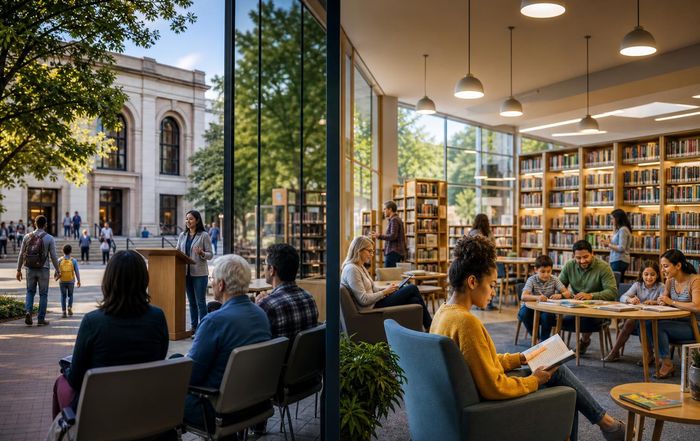
The Place of Public Libraries in American Community Life
In thousands of towns and cities across the United States, the public library is often one of the few places where anyone can walk in, sit down, and stay as long as they like-without paying. That simple fact underpins why libraries remain central to American community life even as reading, learning, and entertainment move online. Far from being just book-lending institutions, modern public libraries are hubs for digital access, civic engagement, cultural exchange, workforce support, very much needed adult education and some social connection, especially for people who have few other options.
From book depositories to community anchors
Public libraries in the US emerged in the 19th century as part of a broader movement to expand education and civic participation. Philanthropists such as Andrew Carnegie funded hundreds of buildings on the belief that access to knowledge could help people improve their lives. Over time, local governments took on funding responsibilities and libraries became part of the public infrastructure alongside schools, parks, and transit.
In the 20th century, as mass media, television, and later the internet reshaped how people access information, some predicted that libraries would fade into irrelevance. Instead, they adapted. The rise of professional librarianship, the expansion of children's services, and the growth of multimedia collections turned libraries into multifaceted learning environments. Today, organizations such as the American Library Association (ALA) and the Institute of Museum and Library Services (IMLS) emphasize the role of libraries as "community anchors" and "civic hubs," not just warehouses of print. This evolution parallels broader social shifts: as many third places-cafés, local newspapers, civic clubs-struggle or close, the public library frequently takes on functions that other institutions once provided.
Equal access to information in a digital age
In an era where so much of life is mediated through screens, the library's role as a guarantor of information access has become even more critical. According to data compiled by the Pew Research Center and IMLS, tens of millions of Americans rely on public libraries for free internet access and computer use each year. For people without home broadband, smartphones with generous data plans, or quiet workspaces, the library can be the only practical gateway to online education, job applications, telehealth, and government services.
Librarians have had to develop new skills as digital navigators. Many libraries offer one-on-one help with tasks such as creating email accounts, navigating government benefit portals, or learning how to use productivity software. Some systems partner with schools and community organizations to provide devices and hotspots for checkout, a trend that accelerated during the COVID-19 pandemic when remote schooling exposed deep digital divides. The Federal Communications Commission's E-Rate program and emergency broadband initiatives have supported these efforts, but local libraries often do the on-the-ground work of helping residents understand and actually use these resources.
This role aligns with broader concerns about health, wellbeing, and social determinants of health, topics explored in WorldsDoor's health and society coverage. When information, benefits, and appointments move online, lack of digital access can quickly translate into worse outcomes in education, employment, and healthcare. Public libraries help soften those inequalities by ensuring that digital transformation does not leave people behind.
Lifelong learning beyond formal education
For many Americans, learning does not end with school, and the library is one of the few institutions that explicitly supports lifelong education without enrollment barriers. Public libraries curate collections and programs for all ages: storytime for toddlers, homework help for students, language-learning groups for immigrants, and lectures or book clubs for adults and older residents.
This educational mission has expanded to include skills that go beyond traditional literacy. Many libraries now run workshops on financial literacy, media literacy, and critical thinking-areas where misinformation and predatory practices can easily harm people. Partnerships with universities, community colleges, and organizations such as Coursera, edX, or Khan Academy allow libraries to introduce patrons to online courses and learning platforms they might not discover on their own. In some cities, residents can even earn accredited high school diplomas through library-supported online programs, illustrating how libraries complement more formal education systems rather than competing with them.
Children's services remain a core part of this work. Research highlighted by groups like Reading Is Fundamental and the National Institute of Child Health and Human Development shows the importance of early literacy and language exposure. Libraries respond with summer reading programs, parent-child reading sessions, and outreach to schools and childcare providers. These initiatives are not only about getting children to read more; they also help families build routines around learning and give caregivers low-cost ways to support a child's development.
Community space in an era of isolation
As many social interactions move online and commercial spaces dominate city centers, the public library stands out as one of the last genuinely public indoor places where no purchase is required. Sociologists sometimes describe libraries as "third places"-neither home nor work-where people can encounter others across lines of age, income, culture, and politics. This function has become more visible as loneliness and social isolation gain recognition as public health concerns, highlighted by organizations such as the World Health Organization and the US Surgeon General's Office.
Library buildings often host community meetings, local history exhibits, cultural celebrations, and civic dialogues. In many communities, they serve as neutral venues for town halls, candidate forums, or workshops on issues such as climate resilience, housing, or public safety-topics that intersect with WorldsDoor's world, environment, and ethics coverage. The physical design of new or renovated libraries increasingly reflects this role, with flexible spaces, meeting rooms, makerspaces, and quiet study areas coexisting under one roof.
For young people in particular, the library can be a refuge. Teen rooms, gaming events, and creative workshops provide alternatives to hanging out in commercial spaces or online-only communities. For older adults, library programs can reduce isolation through social clubs, technology training, or simply a familiar place to read and talk. These roles may not always show up in circulation statistics, but they are central to how many residents experience their local library.
Libraries as cultural and civic institutions
Public libraries also act as cultural memory keepers and civic information hubs. Many collect local history materials-photographs, newspapers, oral histories, and ephemera that might otherwise be lost. These collections allow residents to explore how their communities have changed over time, and they support researchers, journalists, and students who are interested in local stories. Partnerships with organizations such as the Library of Congress and state archives help digitize and preserve these materials for wider access.
Civically, libraries often provide nonpartisan information about elections, government services, and public policy. During election seasons, they may host voter registration drives or display information about how to vote and what identification is required, drawing on resources from agencies like the US Election Assistance Commission. Librarians generally avoid endorsing candidates or parties, but they do help residents navigate ballots, understand how to find credible sources, and distinguish official government sites from misleading lookalikes.
This commitment to intellectual freedom and access is guided by professional ethics articulated by the ALA, which defends the principles of free expression and privacy. That stance has brought libraries into the center of cultural and political debates, especially around book challenges and content related to race, gender, and sexuality. These controversies illustrate how deeply libraries are woven into questions of identity, values, and democracy in American life.
Supporting work, entrepreneurship, and local economies
Beyond education and culture, public libraries play a quiet but significant role in local economies. Many branches host job-search workshops, résumé clinics, and mock interviews, often in partnership with workforce development agencies or local employers. They provide access to job boards, career databases, and certification training materials-services that can be especially valuable for people changing careers, reentering the workforce, or navigating layoffs.
Entrepreneurs and small business owners also benefit. Libraries frequently offer access to market research databases, business planning tools, and legal information that might otherwise be costly. Some systems run dedicated business centers or innovation labs with mentorship, networking events, and even coworking-style spaces. These activities overlap with themes covered in WorldsDoor's business and innovation sections, particularly where local entrepreneurship intersects with technology and community development.
The economic value of libraries is not limited to direct services. Studies supported by organizations such as the Urban Libraries Council and various state library agencies have attempted to quantify the return on investment from public library funding, often finding that every public dollar spent yields multiple dollars in community benefit through increased literacy, workforce readiness, and neighborhood attractiveness. While methodologies differ and such estimates should be interpreted cautiously, they reinforce what many local leaders already observe: thriving libraries tend to be associated with vibrant, resilient communities.
Technology, makerspaces, and the future of learning
Over the past decade, many libraries have embraced roles that would have been unimaginable in the Carnegie era. Makerspaces, recording studios, 3D printers, robotics kits, and virtual reality headsets have become common in larger systems and are slowly spreading to smaller ones. These tools are not adopted for novelty alone; they are intended to give residents hands-on experience with technologies that shape modern work and creativity.
Libraries partner with local schools, universities, and tech organizations to offer coding workshops, digital storytelling projects, and STEM clubs. For young people, this can be an accessible entry point into fields like engineering, design, or computer science. For adults, it can demystify technologies that can feel intimidating. Organizations such as Code.org and MIT Media Lab have influenced many library-based coding and maker programs, even when the specific branding is local.
At the same time, libraries are experimenting with new ways of delivering content. E-books, audiobooks, and streaming media are now standard offerings through digital platforms licensed by libraries. During the pandemic, digital circulation surged, and usage remains high. While licensing costs and access models have sparked debates between publishers and libraries-monitored by groups like the ALA and the Association of American Publishers-the overall trend is clear: public libraries now operate in both physical and digital space, attempting to ensure that residents can access materials in the formats that best suit their lives.
These developments connect with broader technology trends that WorldsDoor explores in its technology coverage, especially around equitable access and the social impact of innovation. Libraries are often on the front lines of these issues, translating abstract debates about algorithms, platforms, and AI into practical questions about how people actually use technology in daily life.
Social services, safety nets, and ethical dilemmas
As other public services face cuts or become harder to access, libraries increasingly function as informal social service points, especially in urban areas. People experiencing homelessness may use libraries as day shelters, places to charge phones, or safe spaces to rest. Social workers, public health nurses, or outreach teams sometimes collaborate with library staff to connect patrons with housing, mental health services, or addiction support. Organizations like the National Alliance to End Homelessness and local health departments have recognized libraries as important partners in reaching vulnerable populations.
This expansion of roles raises ethical and practical questions. Librarians are not trained social workers or security professionals, yet they regularly navigate complex situations involving mental health crises, substance use, or family conflict. Professional bodies and training programs increasingly address trauma-informed service, de-escalation, and staff wellbeing, but resources vary widely by community. These tensions intersect with broader debates about public safety, policing, and social welfare, areas that also surface in discussions of society and ethics.
Privacy is another ethical concern. Libraries have long championed the confidentiality of patron records, and many state laws protect library data from routine disclosure. However, digital services, third-party platforms, and data analytics introduce new risks. When patrons access e-books, databases, or online learning tools, information about their reading and research habits may pass through private companies or cloud services. The ALA and civil liberties organizations such as the Electronic Frontier Foundation have urged libraries to scrutinize vendor privacy practices and educate users about digital footprints. Balancing convenience, cost, and privacy is an ongoing challenge.
Funding pressures and political battles
Despite their wide-ranging contributions, public libraries are not guaranteed stable support. Funding structures vary: some rely heavily on municipal budgets, others on dedicated property tax levies or district funding, and many augment public funds with grants and donations. Economic downturns often bring budget cuts, hiring freezes, and reduced hours. Rural libraries and small-town branches can be particularly vulnerable, even though they may be the only major cultural or educational institution within many miles.
In recent years, political and cultural conflicts have added new pressures. Book challenges and efforts to restrict access to materials on race, LGBTQ+ topics, or contested historical narratives have led to heated school board and library board meetings, staff harassment, and, in some cases, attempts to defund or close libraries. Organizations such as the ALA's Office for Intellectual Freedom and the PEN America writers' group track these trends and advocate for the freedom to read. Supporters argue that libraries must serve diverse communities and viewpoints, while critics contend that certain materials are inappropriate for children or violate community standards.
These conflicts highlight a fundamental tension: libraries are funded by local communities but guided by professional ethics that emphasize broad access and neutrality. Striking a balance is not simple, especially in polarized environments. Yet the intensity of these debates underscores how central libraries remain to American cultural and civic life. They are not peripheral institutions; they sit at the heart of arguments about what kind of society people want to build.
Sustainability, design, and the library as a civic symbol
As cities and towns rethink their built environments in light of climate change and sustainability goals, new and renovated libraries increasingly serve as testbeds for greener public buildings. Architectural projects often incorporate energy-efficient systems, natural light, and flexible spaces that can adapt to changing needs. Organizations like the US Green Building Council have highlighted library projects that achieve high standards of environmental performance, reflecting broader commitments to sustainable environment and sustainable development.
Beyond technical features, library design carries symbolic weight. Prominent central libraries often become landmarks and sources of civic pride, signaling that a community values knowledge, culture, and public life. Smaller neighborhood branches, while less architecturally celebrated, can have an equally powerful impact simply by being accessible, welcoming, and responsive to local needs. In many places, the library is the most visible expression of public investment in shared spaces and shared futures.
How communities can strengthen their libraries-and vice versa
The relationship between public libraries and their communities is reciprocal. Libraries support residents, but they also depend on them. When people understand the breadth of what their library offers, they are more likely to use it, advocate for it, and vote for funding measures that keep it strong.
Residents can engage in several ways: borrowing materials, attending programs, volunteering, supporting friends-of-the-library groups, and participating in public discussions about library policies and priorities. Local journalists and civic organizations can help by covering library issues thoughtfully, drawing on reporting from outlets such as NPR, The New York Times, or ProPublica when national context is useful. Educators, health providers, and social service agencies can deepen partnerships that leverage library spaces and staff expertise.
For their part, libraries that listen closely to community needs-through surveys, advisory boards, and outreach-are better positioned to remain relevant. That might mean expanding multilingual collections in immigrant neighborhoods, investing in assistive technologies for people with disabilities, or developing targeted programs around health literacy, climate resilience, or digital safety. These choices connect libraries to wider global questions about culture, technology, and equity that we explore across the fresh culture, new technology, and globally minded world pages.
Public libraries in the United States are not relics of a pre-digital age. They are evolving institutions that reflect and shape how communities learn, connect, and govern themselves. As debates about information, democracy, and public space intensify, the local library remains a quietly radical idea: that everyone, regardless of income or background, deserves a place where knowledge, culture, and community are freely available on the other side of an open door.