

Understanding Regional Accents and Identity in the United Kingdom
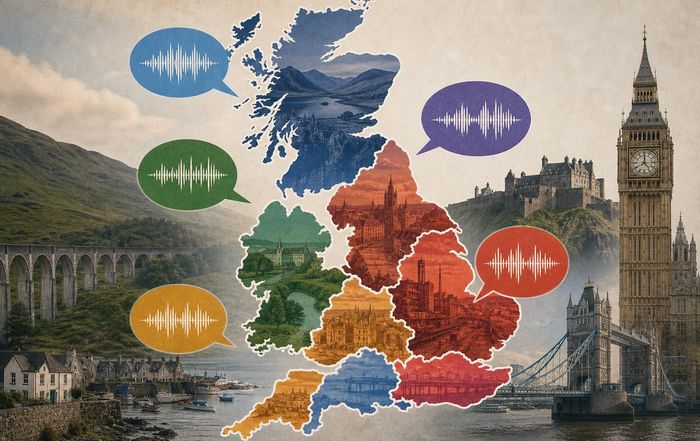
For a relatively small group of islands, the United Kingdom contains an extraordinary range of accents and dialects. A few hours on a train can take a listener from the clipped vowels of southern England to the rolling Rs of Scotland, the musical lilt of Wales, or the distinctive cadences of Northern Ireland. These differences are more than curiosities of pronunciation. In everyday life, accents in the UK are deeply tied to class, region, history, and belonging, and they still shape how people are perceived at work, in politics, in the media, and even when travelling abroad.
This article explores how regional accents developed across the UK, how they intersect with social class and identity, and why attitudes towards them are slowly-but unevenly-changing. It also considers what this means in practice for education, employment, and social mobility, and how people navigate having more than one "voice" depending on where they are and who they are speaking to.
How the UK's accent landscape became so diverse
The UK's accent diversity is rooted in centuries of migration, conquest, and industrial change. The islands' linguistic history includes Celtic languages (Welsh, Scottish Gaelic, Irish), Latin from the Roman occupation, Germanic influences from Anglo-Saxons and Vikings, Norman French after 1066, and later contact through trade and empire. Each wave left traces in pronunciation, vocabulary, and grammar that survive in modern English varieties.
In England, the north-south divide in speech partly reflects old boundaries between areas influenced by Norse settlers and those more shaped by southern Anglo-Saxon dialects. Features like the short "a" in words such as "bath" and "grass" in much of the North contrast with the longer vowel in much of the South. In Scotland, English evolved alongside Scots-a Germanic language variety with its own rich literary history-and Scottish Gaelic, a Celtic language still promoted by bodies such as Bòrd na Gàidhlig and supported by the Scottish Government. In Wales, English developed in close contact with the Welsh language, which is actively protected and promoted by the Welsh Government and S4C, the Welsh-language broadcaster. Northern Ireland's accent landscape reflects Irish Gaelic, Scots, English, and later political and religious divisions.
Industrialisation also reinforced local speech patterns. Growing cities such as Liverpool, Manchester, Glasgow, and Belfast drew workers from surrounding regions, creating dense, often working-class communities where distinctive accents became markers of solidarity and local pride. In port cities like Liverpool, contact with Irish migrants and international sailors added further layers of influence. Over time, these speech patterns became strongly associated with particular industries-coal mining, shipbuilding, textiles-and with the social identities built around them.
Today, linguists at institutions such as University College London, the University of Edinburgh, and Queen's University Belfast continue to study how these accents evolve. Mass media, internal migration, globalisation, and digital communication are all reshaping the accent map, but they have not erased local differences. In some cases, they have made people more conscious of their speech as a visible (or audible) part of who they are.
From RP to "multicultural" voices: the changing sound of English
For much of the 20th century, one accent dominated formal public life in Britain: Received Pronunciation (RP), sometimes called "BBC English" or "the Queen's/King's English". RP is not tied to any specific region; historically it was associated with private education and the upper and upper-middle classes in southern England. Broadcasters, actors, and newsreaders were expected to use it, and it became a yardstick against which other accents were implicitly judged.
That dominance is now weaker. From the late 20th century onward, the BBC and other broadcasters gradually diversified their on-air voices, reflecting criticism from linguists, campaigners, and audiences that a single prestige accent did not represent the country. Today, regional varieties-from Geordie and Scouse to Glaswegian, Cardiff English, and Belfast English-are far more common in news, documentaries, and entertainment. British sign language and multilingual programming have further expanded the idea of what "British speech" looks and sounds like.
At the same time, new urban varieties have emerged, especially in London and other diverse cities. Linguists describe Multicultural London English (MLE) as a set of speech features influenced by Caribbean, West African, South Asian, and other communities, as well as traditional Cockney. Similar "multicultural" or "multiethnolect" varieties have been noted in cities such as Birmingham and Manchester. These accents reflect contemporary patterns of migration and youth culture and are linked to music, fashion, and street culture as much as geography.
The British Library and BBC have both documented changing attitudes to accents, highlighting how younger generations are often more accepting of diversity in speech while still absorbing older stereotypes. Yet RP retains prestige in some elite institutions, and many people still feel pressure to sound "neutral" or "professional" in certain settings, especially when addressing national or international audiences.
Accent, class, and power: who gets to sound "professional"?
In the UK, accent is tightly woven into ideas of social class. Surveys by organisations such as the Social Mobility Commission and Sutton Trust have repeatedly found that people with working-class or strongly regional accents often report discrimination or self-censorship at university admissions, job interviews, and in professional workplaces. Certain accents-particularly those associated with industrial cities or the urban working class-are still sometimes labelled "uneducated" or "rough", despite there being no linguistic basis for such judgments.
Sociolinguistic research, including work by scholars like Peter Trudgill and Llamas & Watt, has shown that all accents are equally complex and rule-governed from a linguistic perspective. Prestige and stigma arise from social and historical hierarchies, not from inherent qualities of the speech itself. RP became dominant because it was associated with power, wealth, and education, not because it is "clearer" or "more correct" in any objective sense.
Nonetheless, accent bias persists. Law, finance, politics, and parts of the media still lean heavily towards southern, middle-class speech norms, even as they diversify. Some people from northern England, parts of Scotland, Wales, or Northern Ireland report softening their accent or adopting more "standard" features to avoid negative reactions. This process-sometimes called "accent accommodation" or "dialect levelling"-can be conscious or unconscious.
At the same time, there is a counter-trend: many politicians, broadcasters, and business leaders now emphasise their regional roots as part of an authenticity narrative. The election of MPs with strong regional accents, the prominence of Scottish and Welsh voices in devolved politics, and the popularity of broadcasters speaking with recognisable local intonation all signal a shift in what counts as authoritative. Yet this visibility does not automatically dismantle structural bias. Tokenism, stereotyping, and expectations that some accents are acceptable only in entertainment or "human interest" roles still shape who gets heard where.
Readers interested in how these hierarchies play out in workplaces may find broader discussions of inequality and fairness in the society and business coverage at worldsdoor.com/society.html and worldsdoor.com/business.html.
Regional pride and belonging: what accents mean to communities
Beyond questions of prestige, accents are central to how many people in the UK understand where they belong. For a Glaswegian, a Liverpudlian, a Cornish speaker, or a resident of the Welsh valleys, local speech can be a source of pride, humour, and shared history. It signals membership in a community that often predates modern national borders or recent political arrangements.
In Scotland and Wales, accents and dialects interact with indigenous languages and national movements. For Welsh speakers, the relationship between Welsh and English accents can be part of a broader project of cultural and linguistic revival supported by institutions like Cymdeithas yr Iaith and public policy. In Scotland, debates about the status of Scots and Scottish Gaelic, and their relationship to Scottish varieties of English, are tied to questions of national identity and devolution. In Northern Ireland, where identity is often contested, subtle differences in pronunciation or vocabulary can signal religious, political, and community affiliations, sometimes in ways outsiders may not hear.
Local pride is also visible in popular culture. British television, radio, and streaming platforms frequently showcase regional comedy, drama, and music that draw on specific speech patterns for character, authenticity, or subversion. Accents like Scouse, Brummie, Mancunian, Yorkshire, and Geordie have distinctive musical and sporting cultures attached to them, reinforcing a sense of place. This can be empowering, but it can also risk caricature when writers lean on exaggerated stereotypes rather than lived reality.
For travellers exploring the UK, paying attention to these varieties can be an entry point into understanding local cultures more deeply. Just as regional food, music, and festivals offer windows into community life, so too do the ways people greet each other, tell stories, and joke in their own voices. Readers interested in connecting language with place may find related perspectives in the travel and culture sections at worldsdoor.com/travel.html and worldsdoor.com/culture.html.
Language, migration, and new urban identities
While many discussions of UK accents focus on long-standing regional varieties, migration has created new linguistic landscapes in cities and towns across the country. Post-war immigration from the Caribbean, South Asia, Africa, Eastern Europe, and elsewhere has introduced new languages, rhythms, and vocabularies into British English. Over generations, these influences have blended with local dialects to produce distinctive urban accents and youth varieties.
London offers the most documented example, with Multicultural London English. Influenced by Jamaican English, West African Englishes, South Asian Englishes, and older Cockney forms, it is widely used by young people of many ethnic backgrounds, not only those from migrant families. Linguists at King's College London and Queen Mary University of London have shown how MLE features-such as certain vowel shifts, intonation patterns, and slang-have spread beyond the capital through music, social media, and internal migration.
Similar patterns appear in cities like Birmingham, Leeds, and Manchester, where "multicultural urban British English" varieties mix local dialect features with influences from Punjabi, Urdu, Polish, Somali, and other languages. These speech forms often become symbols of youth identity, street culture, and musical scenes such as grime, drill, and UK rap. They can also attract moral panic or media scrutiny, echoing earlier anxieties about Cockney, Scouse, or Brummie speech.
Internationally, organisations like the British Council highlight how English in the UK is now one node in a global network of Englishes, influenced by and influencing varieties in North America, Africa, Asia, and the Caribbean. For many young people in Britain, their accent doesn't just signal a region; it reflects a global cultural and linguistic heritage. This complicates older maps that treated "regional accents" as neatly bounded entities.
Accent bias in education and the workplace
Schools, universities, and workplaces are key sites where attitudes towards accents are formed and reinforced. Teachers, lecturers, and managers make everyday decisions-often unconsciously-about what counts as "clear", "appropriate", or "professional" speech. These judgments can affect grades, hiring decisions, promotion prospects, and confidence.
Research supported by bodies such as the Economic and Social Research Council (ESRC) and advocacy groups including the Accent Bias Britain project has documented several recurring patterns. Students with strong regional or working-class accents sometimes report being corrected more often, or told that their speech will hold them back. University students arriving from rural or industrial areas can feel pressure to "tone down" their accent to fit in with peers from more privileged backgrounds. In some cases, accent-based teasing or exclusion shades into bullying.
In workplaces, especially in sectors like law, finance, and consulting, employees may feel compelled to adopt a more RP-like accent in client-facing roles, even if their organisation publicly celebrates diversity. Call centre workers and customer service agents may be trained to adopt "neutral" speech, which can erase regional identity and reinforce the idea that only certain voices sound authoritative or trustworthy. Meanwhile, other sectors-such as regional broadcasting, local government, or community health-may value local accents as signs of relatability and trust.
These dynamics intersect with race, gender, and disability. For example, Black and Asian Britons with regional or multicultural accents may face both racialised and class-based stereotypes about their competence or "fit". People with speech impediments or conditions affecting speech may be judged against an ideal of fluency that is already skewed towards a narrow standard. Organisations concerned with equality, such as the Equality and Human Rights Commission, have begun to acknowledge accent as a potential dimension of discrimination, even though it is not a standalone protected characteristic in UK law.
For fans interested in broader questions of health, stress, and wellbeing in relation to identity and discrimination, related themes are discussed in the health and lifestyle pages at worldsdoor.com/health.html and worldsdoor.com/lifestyle.html.
Code-switching and style-shifting: living with more than one voice
Many people in the UK naturally adjust their accent or speech style depending on context-a practice linguists call style-shifting or code-switching (the latter more commonly used when switching between languages or very distinct varieties). Someone from Newcastle might sound more "Geordie" with family than in a job interview; a Welsh speaker might move between Welsh and English or between different English accents; a Londoner might use more MLE features with friends and more standard forms with older relatives.
This flexibility is not necessarily inauthentic. Humans routinely adapt their language to context, audience, and purpose. The problem arises when social pressures make certain accents seem unacceptable in formal settings, forcing people to distance themselves from their communities or feel that their "real" voice is unprofessional. Some individuals describe this as emotionally tiring or as creating a sense of split identity: one voice for home, another for work.
At the same time, deliberate style-shifting can be empowering. It can allow people to navigate multiple worlds, maintain ties to their local community, and still access opportunities that may be gatekept by standard language expectations. Artists, comedians, and writers often play with this, switching accents for effect and challenging assumptions about whose voices belong in particular spaces.
Digital communication adds another layer. Voice notes, video calls, podcasts, and social media give people new ways to present their speech to different audiences. Platforms like YouTube, TikTok, and Spotify have made it easier for creators with a wide range of accents to reach large audiences without passing through traditional media gatekeepers. This visibility can normalise accent diversity and provide role models for younger people who rarely heard their own voices in national media a generation ago.
Tourism, media, and the global imagination of "British" accents
Outside the UK, many people encounter only a narrow slice of its accent diversity-often RP or a stylised version of Cockney in films and television. International media, from Hollywood productions to global streaming platforms, can reinforce clichés about British speech: the villain with an aristocratic accent, the comic character with a strong regional voice, the quaint rural dialect played for charm or confusion.
Tourism marketing sometimes leans on these images, presenting certain accents as part of a romanticised national character. At the same time, visitors who travel beyond London often discover a far more varied soundscape, from the rapid-fire delivery of Glaswegian speech to the softer, rounded vowels of the West Country. For culturally curious travellers, engaging respectfully with these differences-listening carefully, asking about local words, being patient with unfamiliar rhythms-can deepen understanding of the places they visit.
Streaming platforms and international broadcasters such as the BBC, Channel 4, ITV, and Netflix have, however, increasingly showcased regional and minority voices in drama and documentary. Series set in places like Yorkshire, Northern Ireland, or the Scottish Highlands expose global audiences to accents that were once rarely heard outside those areas. This can challenge stereotypes but also risks new forms of typecasting if particular accents become associated only with specific genres (for example, crime dramas or gritty social realism).
For well travel individuals interested in how media representation shapes global perceptions of places and cultures, related themes are explored in the world and education sections at worldsdoor.com/world.html and worldsdoor.com/education.html.
Policy, activism, and the push to tackle accent discrimination
In recent years, awareness of accent bias in the UK has grown. Academic projects, charities, and campaigners have begun to frame accent discrimination as a social mobility issue, linking it to unequal access to education and high-status professions. The Social Mobility Commission, Sutton Trust, and Joseph Rowntree Foundation have all highlighted how class and regional background continue to shape life chances, with accent as one visible marker of these inequalities.
Some universities now run workshops to help staff recognise and counteract accent bias in admissions and assessment. Professional bodies in law, accounting, and medicine have started to discuss how recruitment practices may disadvantage candidates who do not sound like existing elites. The BBC and other broadcasters have periodically reviewed their policies on on-air voices, aiming to expand representation across regions and social backgrounds.
There is no specific UK law banning accent discrimination in the way that discrimination on grounds of race, sex, or disability is prohibited. However, accent bias can intersect with protected characteristics-for example, when it is linked to racial or national origin stereotypes. Organisations such as the Equality and Human Rights Commission and ACAS provide guidance on inclusive hiring and workplace behaviour that, while not accent-specific, can be used to challenge unfair treatment related to speech.
Grassroots activism also plays a role. Social media campaigns, podcasts, and online communities allow people to share experiences of accent prejudice and celebrate local speech. Teachers and parents swap resources for valuing dialect in classrooms while still teaching standard English as a useful additional variety rather than the only correct form. Some linguists and educators advocate a "both/and" approach: recognising standard English as a practical tool for exams and formal writing, while affirming that home accents and dialects are legitimate, rich forms of expression.
People interested in broader questions of fairness, sustainability, and ethics in social systems may find further analysis in the ethics and sustainable sections at worldsdoor.com/ethics.html and worldsdoor.com/sustainable.html.
Listening differently: what accent diversity can teach
Understanding regional accents in the UK is ultimately about more than learning to tell a Mancunian from a Bristolian voice. It invites a different way of listening-one that treats speech not as a test of correctness but as a record of history, movement, and identity. Each accent reflects layers of migration, work, inequality, resistance, and creativity. Hearing them with curiosity rather than judgment can open up richer conversations about who feels at home where, and why.
For people within the UK, becoming more aware of accent bias can prompt reflection on everyday interactions: whose voices are interrupted, whose are taken as expert, whose are mocked or imitated. For visitors, paying attention to local speech can deepen travel beyond sight-seeing, connecting landscapes to the people who live in them. For educators, employers, and policymakers, accent diversity raises practical questions about how to design systems that value different ways of speaking without entrenching old hierarchies.
In a world where mobility, digital communication, and global culture continue to reshape how people talk, the UK's dense mosaic of accents offers a case study in how language and identity evolve together. The challenge-and opportunity-is to ensure that this richness becomes a source of inclusion rather than a barrier, so that the way someone sounds opens doors rather than quietly closing them.